
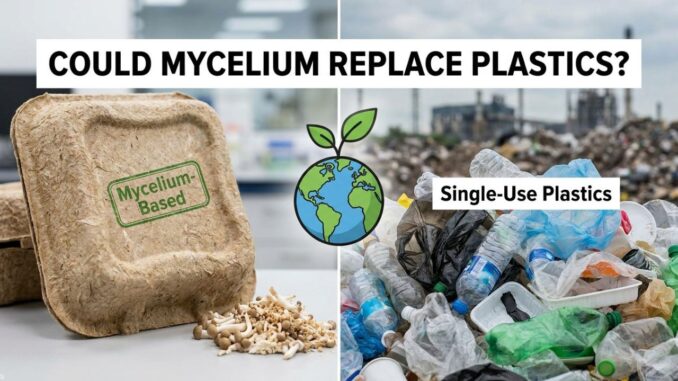
Packaging waste accounts for roughly 30% of all waste generated in the United States, and a significant proportion of that waste is single-use plastic and expanded polystyrene foam, materials that take centuries to break down and that have become a defining symbol of the environmental cost of modern consumer culture. Governments across the world have responded with bans and restrictions: numerous Australian states have moved to phase out expanded polystyrene under single-use plastic bans, the UK has implemented a plastic packaging tax targeting materials with insufficient recycled content, and the EU has set ambitious targets for reusable, recyclable, or compostable packaging.
Into this regulatory and environmental pressure has stepped an unlikely candidate for disruption: mushrooms, or more precisely, mycelium, the root-like network of fungal threads that underlies mushroom growth. Mycelium-based biomaterials, created by growing fungal networks through agricultural waste like sawdust, hemp husks, and corn stalks, have emerged as a genuine commercial alternative to expanded polystyrene and other single-use plastic packaging. The global mushroom packaging market was valued at approximately $68 million in 2024 and is projected to roughly double to $142 million by 2034. The question this essay addresses is whether that growth trajectory represents a genuinely scalable replacement for single-use plastics in global packaging, or whether mycelium remains a niche, premium product limited to environmentally conscious brands willing to pay a sustainability premium.
The Case For: Mycelium Packaging Is Already Working at Scale
The most compelling evidence for mycelium’s viability comes from real commercial deployments by major brands, not just pilot projects or proof-of-concept demonstrations. Dell has replaced foam packaging for laptops with mycelium-based alternatives in its supply chain. IKEA has trialled mycelium packaging as part of its zero-waste goals for flat-pack furniture. These are not small sustainability-focused startups experimenting at the margins. They are two of the largest consumer goods companies in the world, integrating mycelium packaging into supply chains that ship millions of units globally. When companies operating at that scale adopt a material, it signals that the material has cleared baseline thresholds for cost, durability, and manufacturing compatibility that smaller pilots cannot demonstrate.
The performance characteristics of mycelium packaging are genuinely comparable to the polystyrene foam it aims to replace. Czech company Myco, winner of a Red Dot design award in 2024 for its MYCO 4Pack product, has demonstrated that its mycelium packaging performs comparably to, and in some tested cases better than, expanded polystyrene, expanded polyethylene, and polyurethane foam for shock and vibration absorption. Camea, a manufacturer of sensitive electronic devices, reported superior product protection after switching from plastic foam to MYCO 4Pack. This matters because the most common objection to bio-based alternatives, that they sacrifice performance for sustainability, does not appear to hold for mycelium packaging in protective packaging applications.
The production process itself offers structural advantages over conventional manufacturing. Mycelium-based materials grow into their final shape over a period of five to seven days when fungal spores are introduced to a mould filled with agricultural waste. The mycelium digests the waste material and binds it into a solid, lightweight structure that can then be dried and finished. This growth-based production process requires significantly lower energy input than the petrochemical extraction, refining, and moulding processes required for polystyrene. The raw material input is agricultural waste, a byproduct that would otherwise require disposal, giving mycelium production a genuinely circular economy profile: it converts a waste stream into a useful product that, at end of life, decomposes naturally within 30 to 90 days without leaving toxic residues.
Myco’s technology specifically addresses the cost and compatibility concern that has historically limited bio-based packaging adoption. The company has developed a continuous production line for preparing and drying mycelium material alongside a streamlined moulding process, enabling production at a scale that can compete with established polystyrene packaging on both performance and price. This is a critical development, because previous generations of mycelium packaging products were often significantly more expensive than conventional alternatives, limiting adoption to brands willing to pay a sustainability premium. If Myco’s claims about price competitiveness hold up at full commercial scale, the primary economic barrier to mycelium adoption would be substantially reduced.
The Case Against: The Limits of Mycelium at Global Scale
The honest assessment of mycelium packaging’s potential has to start with the scale of the problem it is trying to solve relative to the scale of the industry attempting to solve it. The global packaging foams market, the broader category that includes expanded polystyrene and similar materials, is valued at approximately $30 billion. The mycelium packaging market, even after projected doubling to $142 million by 2034, would represent less than half a percent of that market. The growth rate is genuinely impressive in percentage terms, but the absolute scale gap between mycelium packaging today and the global packaging foam market it would need to displace to constitute a genuine “replacement” is enormous.
The growth-based production process, while elegant and low-energy, introduces a fundamental constraint that injection-moulded plastic does not face: time. Polystyrene packaging can be moulded in seconds. Mycelium packaging requires five to seven days to grow into shape, plus additional drying and finishing time. For industries with rapid production cycles and just-in-time manufacturing models, a multi-day production lead time for packaging components represents a significant supply chain adjustment. Scaling mycelium production to meet the volumes required by global consumer goods supply chains would require either an enormous expansion of growing facility capacity, distributed across many locations to manage the logistics of a product with a multi-day production cycle, or accepting that mycelium packaging will remain suited to specific applications where lead times can accommodate the growth process.
Raw material supply also presents a less obvious but real constraint. Mycelium packaging production depends on agricultural waste streams, including sawdust, hemp husks, corn stalks, and similar materials. These waste streams are genuinely abundant in absolute terms, but they are not infinite, and they are not always located near the manufacturing facilities or end markets where packaging is needed. Existing uses for agricultural waste, including animal bedding, mulch, biomass energy generation, and other applications, mean that scaling mycelium production to displace a meaningful share of the $30 billion packaging foam market would create new demand for agricultural waste at a scale that has not been fully assessed for supply chain feasibility.
There is also a durability and use-case limitation that is rarely discussed prominently in coverage of mycelium packaging. Mycelium-based materials decompose naturally within 30 to 90 days, which is a genuine environmental advantage for disposal, but it also means the material is not suitable for any application requiring long-term durability, moisture resistance over extended periods, or storage in humid environments. Polystyrene’s durability, while an environmental liability at end of life, is functionally useful for packaging that may sit in warehouses or shipping containers for extended periods before use. Mycelium packaging’s biodegradability is a feature for disposal and a constraint for storage and logistics, and managing that trade-off across global supply chains adds operational complexity that conventional plastic packaging does not present.
What the Evidence From Real Adoption Tells Us
The evidence from companies that have actually adopted mycelium packaging at scale, including Dell, IKEA, and the manufacturers working with Myco’s MYCO 4Pack, suggests that mycelium packaging is most viable for specific categories of packaging rather than as a universal polystyrene replacement. Protective packaging for electronics and sensitive goods, where the product is shipped once from manufacturer to retailer or consumer and disposed of promptly after use, represents an excellent fit for mycelium’s strengths: good shock absorption, acceptable lead times for planned production schedules, and a disposal profile that aligns with growing consumer expectations for sustainable unboxing experiences.
The regulatory environment is also accelerating adoption in ways that go beyond pure market economics. Single-use plastic bans in Australian states, the UK plastic packaging tax, and similar measures in other jurisdictions are creating compliance-driven demand for alternatives that does not depend solely on mycelium reaching full cost parity with polystyrene on a like-for-like basis. When the alternative to switching is a tax penalty or an outright ban, the cost calculus for adopting mycelium packaging shifts substantially, even if the per-unit cost remains somewhat higher than conventional foam.
The marketing and brand value dimension also appears to be a genuine driver of adoption independent of pure cost or performance considerations. Companies in the sector consistently describe mycelium packaging as a measurable ESG asset and a compelling brand story for environmentally conscious consumers. For companies competing on sustainability credentials, particularly in markets where consumers actively seek out and reward visible sustainability efforts, mycelium packaging functions as both a functional product and a marketing asset, which can justify a price premium that would not be sustainable on cost grounds alone.
The Verdict: A Genuine Solution for Specific Applications, Not a Wholesale Replacement
Mycelium-based biomaterials are realistically positioned to capture a meaningful and growing share of the protective packaging market, particularly for electronics, fragile goods, and applications where biodegradability is a genuine selling point to end consumers. The commercial adoption by Dell and IKEA, the performance validation from Myco’s award-winning product, and the regulatory tailwinds from plastic bans and packaging taxes all point toward sustained, genuine growth in this category over the coming decade.
What mycelium cannot realistically do, at least within any timeframe that current production methods and supply chains suggest, is displace single-use plastics across the full breadth of global packaging applications. The scale gap between current mycelium production and the global packaging foam market remains enormous. The growth-based production process imposes lead time constraints that are fundamentally incompatible with some manufacturing models. And the biodegradability that makes mycelium environmentally attractive also limits its suitability for applications requiring long-term storage durability.
The most realistic outcome is a packaging landscape where mycelium becomes the standard choice for a meaningful subset of protective and consumer-facing packaging applications, growing from its current less than half a percent of the global packaging foam market to a genuinely significant niche, perhaps single-digit percentages, over the next decade. That would represent substantial real-world environmental impact even without constituting wholesale replacement, and it would establish mycelium as a permanent and growing fixture of the packaging industry rather than a passing sustainability trend. For consumers and brands looking at the broader landscape of biological materials displacing synthetic ones, the trajectory of mycelium packaging offers a useful template: genuine, durable growth in specific applications where the material’s characteristics align with the use case, rather than the kind of overnight wholesale transformation that headlines often imply. The same pattern of genuine but bounded disruption is visible in the question of whether lab-grown leather is truly sustainable or a sophisticated marketing story, where similar questions of scale, cost, and application fit determine the realistic ceiling for adoption.
Leave a Reply