
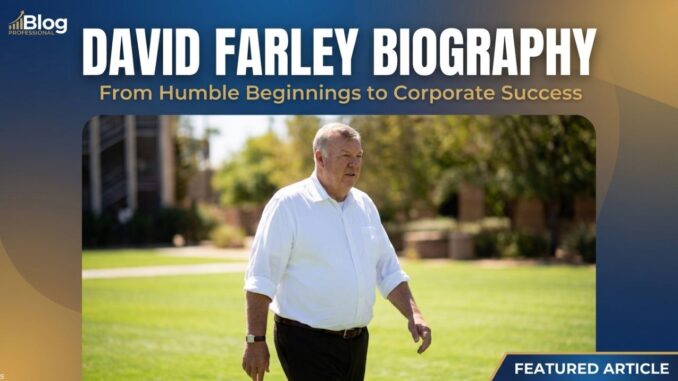
David Farley was born on 16 January 1957 and grew up in Narrandera, New South Wales, Australia, the grandson of a First World War Light Horseman and the son of a Second World War naval veteran who went on to work in agribusiness. He is an agricultural businessman, former CEO of the Australian Agricultural Company, and the Member of Parliament for Farrer since his election on 9 May 2026 as the One Nation candidate, a victory that made history as the first time One Nation had ever won a seat in Australia’s House of Representatives in the party’s thirty-year existence.
His route to that seat is one of the most politically nomadic in recent Australian history. This biography covers his life, his extraordinary career in agriculture, and the political journey that ended with him making history in a rural New South Wales electorate.
Quick Facts About David Farley
| Full Name | David Farley |
| Date of Birth | 16 January 1957 |
| Age | 69 as of 2026 |
| Place of Birth/Hometown | Narrandera, New South Wales, Australia |
| Nationality | Australian |
| Occupation | Member of Parliament for Farrer (One Nation); agribusiness executive |
| Net Worth | Not publicly disclosed |
| Spouse/Partner | Not publicly confirmed |
| Education | Not publicly confirmed; began career as jackaroo aged 18 |
| Key Role | Managing Director and CEO, Australian Agricultural Company (2009-2013) |
| Social Media | @DavidFarleyMP on X (Twitter) |
9 May 2026: The Night One Nation Entered the Lower House
When the votes were counted in Farrer on the night of 9 May 2026, something happened for the first time in thirty years of One Nation history. David Farley, a sixty-nine-year-old agribusiness veteran from Narrandera, won 59.1 percent of the two-candidate preferred vote against independent Michelle Milthorpe, claiming a seat in the House of Representatives for a party that had never held one through direct election in three decades of trying.
ABC election analyst Casey Briggs called the result on the night: “It’s very clear, the next member for Farrer is David Farley. It’s not a close result.” One Nation leader Pauline Hanson and Farley embraced at the Albury victory event. Farley told the crowd and the media that the party “has reached the end of its beginning” and is “going through the ceiling.” It was a statement calibrated for the moment. One Nation had won seats through defections, through Senate contests, and through state elections. It had never done this: won a lower house federal seat from scratch. David Farley was the first.
Early Life and a Career Built From the Ground Up
David Farley was born and raised in Narrandera, a Riverina town on the Murrumbidgee River in southern New South Wales. His family’s connection to both military service and rural industry ran deep: his grandfather served as a Light Horseman in the First World War, and his father served in the Royal Australian Navy in the Second World War before returning to work in agribusiness. That combination of service and land shaped the values Farley would carry through his own career.
He began working in 1975 as a jackaroo with FS Falkiner and Sons in Deniliquin, one of Australia’s oldest and most respected pastoral companies. The jackaroo role is entry-level station work, involving livestock handling, fencing, mustering, and the general demands of large-scale pastoral property management. From that starting point, Farley worked his way up through roles as overseer, station manager, and irrigation development specialist. By 1982, at the age of twenty-five, he had been appointed to lead the development of a major irrigation enterprise in northern New South Wales, a significant responsibility for someone of his age in an industry where advancement usually comes slowly.
Over the following decades, he built a career that took him across the cotton and cattle industries, the Murray-Darling Basin water policy debate, and the highest levels of Australian agribusiness management.
CEO of the Australian Agricultural Company
From December 2009 to July 2013, David Farley served as Managing Director and Chief Executive Officer of the Australian Agricultural Company, known as AACo, one of Australia’s oldest and largest publicly listed cattle producers. Founded in 1824, AACo operates across northern Australia and is one of the country’s most significant beef exporters. Leading it required managing millions of hectares of station country, complex supply chains, and the politics of the live export trade, which was one of the most publicly contested issues in Australian agriculture during his tenure.
During his time as CEO, Farley attracted both admiration and controversy. He supported the hiring of hundreds of Indian migrants to work in the agricultural sector, backing the skilled migration pathways that Australian agriculture depends on. He also clashed publicly with then-National Party senator Barnaby Joyce, accusing Joyce of holding “xenophobic views” by opposing Chinese investment in Australian farmland. The dispute was notable: a major agribusiness CEO publicly attacking a sitting senator from the party that historically represented rural Australia. It was not the action of a man who worried about making enemies in conventional political circles.
He left AACo in 2013. In subsequent years he became chair of Speak Up 4 Water, a lobby group focused on water allocation policy in the Murray-Darling Basin, one of the most contentious and politically charged resource management debates in Australia. His advocacy work on water rights for irrigators positioned him as a prominent and credible voice in the regional communities that would later become his electoral base.
The Political Nomad: From the Nationals to Labor to One Nation
David Farley’s political journey before his One Nation candidacy was one of the most unusual in recent Australian history. He was a member of the New South Wales National Party from 2015 to 2020, the natural political home for someone of his rural agribusiness background. In 2019 he applied to fill a vacancy in the New South Wales Legislative Council but was rejected. In 2020, after departing the Nationals, he applied to join the Australian Labor Party and filled out a form expressing interest in running as a NSW Labor candidate. Labor rejected his membership application. In 2023 he donated money to Voices for Farrer, the community group backing independent candidate Michelle Milthorpe, who would later become his principal opponent in the 2026 by-election.
He joined One Nation sometime in late 2025, well before Sussan Ley announced her resignation from Farrer, which triggered the by-election. He has been direct about his reasoning: Ley’s management of Farrer, particularly on water policy, had disappointed him. He believed the Coalition lacked the courage to take on the fights that mattered to the Riverina and Murray-Darling communities. He found in One Nation a party he felt had both the willingness and the bluntness to advocate for those communities without hedging.
During the campaign, old controversies resurfaced: comments made in 2012 in which he compared then-Prime Minister Julia Gillard to a “non-productive old cow.” Farley and Hanson described the remarks as tongue-in-cheek. Farley also drew criticism for describing crime in Griffith as “hectic” and for sharing social media content from OnlyFans creators, which he said was accidental. The Coalition ran attack advertisements against him, pointing out that he had sought Labor preselection and donated to an independent. None of it was enough to stop him. He won the seat with a margin that made the eventual result far clearer than any poll had predicted. Like another first-time winner covered in this series, Luke Richmond, who won the Queensland Stafford by-election for Labor in May 2026, Farley came through a by-election field crowded with controversy and competing narratives to take the seat.
Personal Life
David Farley is based in Narrandera, the town where he was born and where he has built his career. Details about his spouse or partner have not been confirmed in public sources. He has spoken about his family’s multigenerational connection to service and the land as central to his values and his motivation for entering politics. His persona throughout the campaign was consistently that of a man of the Riverina: practical, direct, and rooted in the agricultural realities of the region he was seeking to represent. He is known in the agribusiness community as someone with deep technical knowledge of irrigation, cattle production, and water policy, and that credibility was central to his appeal in a constituency where those issues are not abstract.
Conclusion
David Farley spent fifty years building a career in Australian agriculture, tried and failed to enter politics through three different parties, and at sixty-nine years old made history by winning a seat in the House of Representatives for a party that had spent three decades trying to achieve exactly that result. The Farrer by-election was not just a personal victory. It was a structural moment in Australian politics: confirmation that One Nation had found a way to convert its Senate and state-level strength into lower house representation, and that the right candidate with deep local credibility could crack seats that had been safe Liberal territory for a quarter century. What Farley does with the opportunity, and whether One Nation can replicate the result, will shape Australian politics for years to come.
Leave a Reply