
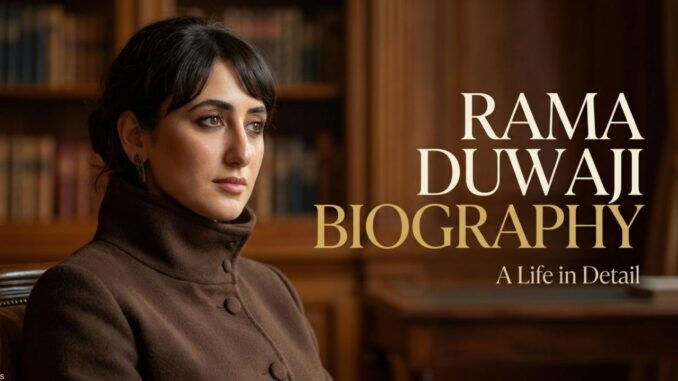
Rama Sawaf Duwaji was born on 30 June 1997 in Houston, Texas, United States, to Syrian Muslim parents originally from Damascus. She is an American animator, illustrator, and ceramist whose work has appeared in The New Yorker, The Washington Post, Vogue, and at institutions including Apple, Spotify, and the Tate Modern. She is also, since 12 January 2026, the First Lady of New York City, as the wife of Mayor Zohran Mamdani. She is 28 years old, making her the youngest and the first Gen Z and first Muslim person to hold the role in New York City’s history. This biography covers the artist before the First Lady, the life she built before politics entered it, and what has changed since.
Quick Facts About Rama Duwaji
| Full Name | Rama Sawaf Duwaji |
| Date of Birth | 30 June 1997 |
| Age | 28 as of 2026 |
| Place of Birth | Houston, Texas, United States |
| Nationality | American |
| Heritage | Syrian-American; parents from Damascus |
| Occupation | Animator, illustrator, ceramist; First Lady of New York City (from January 2026) |
| Husband | Zohran Mamdani (Mayor of New York City) |
| Father | Marwan Duwaji (software developer) |
| Mother | Bariah Dardari (paediatrician and humanitarian aid doctor) |
| Education | Virginia Commonwealth University School of the Arts, Qatar (Communication Arts); VCU Richmond (undergraduate); School of Visual Arts, New York City (MFA Illustration as Visual Essay, 2024) |
| Social Media | @ramaduwaji on Instagram |
The Artist: A Life Built in Lines and Movement
Before Rama Duwaji was anyone’s First Lady, she was a child who got in trouble for drawing in her textbooks. Her teachers scolded her for scribbling in notebooks when she should have been paying attention. She has described drawing as her solace, the thing she reached for when everything else was uncertain or uncomfortable, which in her early life was often. From the beginning, art was not a hobby. It was the medium through which she processed the world.
Her work as an adult reflects that origin. She makes animation and illustration that deals with identity, displacement, diaspora, sisterhood, and humanitarian crisis. She has animated music videos, produced documentary-style shorts for European broadcasters, illustrated for major publications, and created ceramic works that extend her visual practice into three dimensions. Her work has been published by The New Yorker and The Washington Post. It has been commissioned by Apple, Spotify, the BBC, Vogue, and the Tate Modern. After completing her MFA at the School of Visual Arts in New York City in 2024, she was selected as one of twenty-four artists from over five hundred applicants for a prestigious Catskill Mountains artist residency. She has also done residencies in Lebanon and France.
Some of her most recognised projects include an animated music video, “I Won’t Wait,” for Egyptian-American rapper Felukah, which blended fluid animation with political undertones and was released in 2020. For the French-German cultural broadcaster Arte, she produced “Essence of Memory,” a combination of live action and animation following a Syrian refugee in France who is working to become a master perfumer. For the same network she co-created a series of animated shorts about Lebanese and Syrian artisans and their embroidery traditions. Her pantomime online graphic novel “Razor Burn,” from 2018, followed a teenager finding her identity and was presented in comic strip format.
She counts among her artistic influences Ronan Bouroullec, Carson Ellis, Lucian Freud, Ashley Lukashevsky, Rithika Merchant, Rachel Levit Ruiz, and Betsy Walton, a list that spans European design, American illustration, and classical painting, and reflects the breadth of a practice that is not easily categorised by medium or tradition.
Early Life: Houston, Dubai, and Between Two Worlds
Rama Duwaji was born in Houston to Syrian Muslim parents who had married shortly before her birth. Her father, Marwan Duwaji, is a software developer. Her mother, Bariah Dardari, is a paediatrician who has also worked on humanitarian missions in warzones with the Syrian American Medical Society. The family lived initially in Wayne, New Jersey, before moving to Dubai in 2006 following her mother’s appointment at the local American Hospital. Duwaji spent the remainder of her childhood in the Arab states of the Persian Gulf, graduating from high school in Dubai.
Growing up between the United States, New Jersey, and the Gulf gave her a sense of not quite belonging in any of the cultures she moved between. She has spoken about not feeling entirely Syrian, Emirati, or American, and about the difficulty of finding a therapist who could understand her specific viewpoint when coping with depression and anxiety in her early adulthood. Those experiences of in-between-ness and displacement run directly through her artistic work, which returns repeatedly to diaspora, identity, and the question of where home is when home has multiple answers.
She began her higher education at Virginia Commonwealth University School of the Arts in Qatar, studying Communication Arts in Doha, before transferring to VCU’s main campus in Richmond, Virginia, to complete her undergraduate studies. After graduating, she moved to New York City, where she enrolled at the School of Visual Arts for her MFA, completing it in 2024.
Meeting Zohran Mamdani and the Road to Gracie Mansion
Rama Duwaji met Zohran Mamdani on the dating app Hinge in 2021. At the time, Mamdani was a member of the New York State Assembly representing a Queens district. Their first date was at Qahwah House, a Yemeni coffee shop in Brooklyn, followed by a walk through McCarren Park. Mamdani later reflected, “There is still hope in those dating apps.” The relationship developed over four years while Mamdani’s political career intensified and Duwaji built her artistic practice.
They became engaged in October 2024. They held a private nikah ceremony in Dubai two months later, with Duwaji’s family. In February 2025 they married in a civil ceremony at New York City Hall, with a close friend as their only witness and a photographer to document the moment; the three of them took the subway from Astoria to City Hall on a rainy morning. In July 2025, following Mamdani’s victory in the New York City Democratic mayoral primary, the couple held a wedding celebration in Uganda, Mamdani’s birth country. Guests were given one rule: no phones.
On 12 January 2026, the couple moved into Gracie Mansion after Mamdani was inaugurated as the 111th Mayor of New York City. Duwaji became the city’s First Lady, the first Gen Z-er, and the first Muslim person to hold the role in the city’s history. She helped shape the visual identity of Mamdani’s campaign, finalising the brand iconography and font. The campaign’s colour palette, MetroCard orange-yellow, Mets blue, and firehouse red, bore her sensibility. She declined all press appearances during the general election campaign, including a New York Times interview, explaining that the article had already been mostly written and she did not want to participate. Her influence was present throughout; her face was largely absent.
The context that brought her husband to national prominence, including the June 2026 primary wins for candidates Mamdani endorsed, is covered in detail in our profile of Graham Platner, the Maine Democratic Senate nominee who has been compared by some Republican commentators to Mamdani as a representative of the new Democratic left.
The First Lady Role and the Controversy
Duwaji has approached the First Lady role with the same discretion she brought to the campaign. She has no formal role in the Mamdani administration and no official duties. The role of New York City First Lady is not an elected position and carries no job description. When media outlets reported in March 2026 that she had liked several Instagram posts supportive of the Palestinian cause following the October 7 attacks, Mayor Mamdani described her as a “private person” who had liked those posts before the couple married and before he had launched his mayoral campaign. He stated that her personal social media activity should not be held against her or treated as a statement of his administration’s policy.
She has spoken rarely in public. In an April 2026 interview with Yung magazine, she said: “I believe everyone has a responsibility to speak out against injustice.” She has been direct that she does not want to be defined solely as “the mayor’s wife” and intends to continue creating art on her own terms. Mamdani addressed the trolling and abuse she received online after his election directly in an Instagram post: “Rama isn’t just my wife, she’s an incredible artist who deserves to be known on her own terms. You can critique my views, but not my family.”
Personal Life
Rama Duwaji and Zohran Mamdani live at Gracie Mansion, the official mayoral residence on the Upper East Side of Manhattan, having moved from their apartment near Steinway Street in Astoria, Queens, where they had lived during his time in the State Assembly. She is 28 years old, and in her own description, is still figuring out what the First Lady role means for her as an artist, a private person, and a young woman who became a public figure without choosing public life. On election night, as the results came in, she posted a carousel of photo-booth pictures, a voting-sticker selfie, and a childhood photo of her husband, captioned simply: “Couldn’t possibly be prouder.”
Conclusion
Rama Duwaji arrived in public life as an accomplished artist with an MFA, a body of published work, and a practice that engages seriously with displacement, identity, and humanitarian crisis. She did not seek the attention that came with her husband’s election, and she has been consistent in her approach to it: work on her own terms, protect her own space, refuse the reductive label of “mayor’s wife.” At 28 she is the youngest First Lady in New York City’s history, the first Gen Z-er, and the first Muslim person to hold a role that has no formal definition and no job description. What she makes of it, and what she makes in her studio while she holds it, are entirely her own to determine.
Leave a Reply