
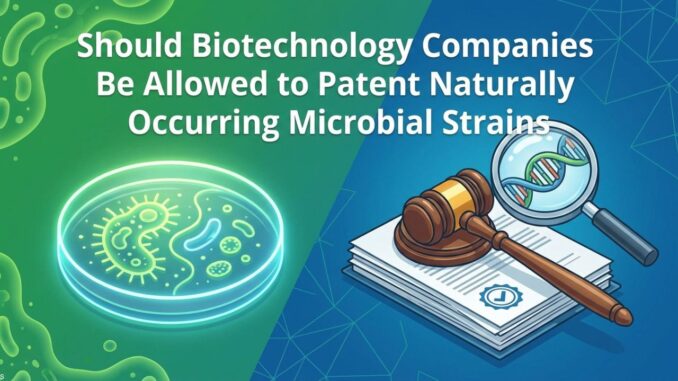
Patents are the lifeblood of the biotechnology industry. A strong patent portfolio is often the single most valuable asset a biotech company owns, the thing that convinces investors to fund years of expensive research, and the legal mechanism that allows a company to commercialise a discovery without a competitor immediately copying it. For an industry where a single successful drug or diagnostic can take a decade and billions of dollars to bring to market, patent protection is not a peripheral business consideration. It is often the entire business model.
But the question of what, exactly, can be patented in biology has never been settled cleanly, and nowhere is the tension more visible than in the patenting of microbial strains. Bacteria, fungi, and other microorganisms exist in nature, in soil, in the human gut, in extreme environments around the world, long before any company isolates and characterises them. When a biotechnology company discovers a naturally occurring microbial strain with a useful property, perhaps a probiotic effect, an industrial enzyme, or a therapeutic application, and successfully patents that strain, what exactly have they invented? This essay examines whether biotechnology companies should be allowed to patent naturally occurring microbial strains, drawing on the legal precedents, the current patent landscape, and the practical consequences for both innovation and access.
The Case For: Why Patent Protection Is Necessary for Innovation
The foundational legal principle that biotechnology companies rely on is that patents do not protect the naturally occurring organism itself, but rather the isolated, characterised, and often modified version of that organism, along with the specific industrial or therapeutic applications discovered through research. The landmark 1980 US Supreme Court case Diamond v. Chakrabarty established this principle decisively. Ananda Chakrabarty, a microbiologist, had developed a bacterium genetically modified to break down crude oil, with clear applications for cleaning up oil spills. The Supreme Court ruled that the modified bacterium constituted patentable subject matter, establishing that living organisms created or meaningfully modified through human intervention could receive patent protection. This case has underpinned biotechnology patent law for over four decades and remains the foundation for why biotech companies can patent engineered organisms.
The economic argument follows directly from this legal foundation. Discovering, isolating, and characterising a microbial strain with commercially useful properties is not a trivial undertaking. It requires screening enormous numbers of candidate organisms, often from environmental samples collected through extensive fieldwork, followed by laboratory characterisation, safety testing, and the development of the specific formulations, delivery mechanisms, or industrial processes that make the strain commercially viable. A company that invests years and substantial capital in this process, only to find that a competitor can immediately replicate the commercial product without any of that investment, faces a fundamentally broken incentive structure. Patents on the specific deposited strain, its characterised properties, and its applications provide the legal certainty that allows companies to recoup R&D investment and attracts the venture capital that funds early-stage biotech research in the first place.
The current patent landscape reflects a system that has, in practice, found a workable middle ground. Analysis of patents granted by the European Patent Office in 2019 and 2020 covering naturally occurring bacteria found that 45% were limited specifically to deposited strains, meaning the patent claim covers a specific physical sample of the organism that has been deposited in an accredited culture collection, along with its descendants, rather than claiming the species or genus broadly. This narrow claiming approach means that a competitor who independently isolates a similar strain from a different environmental source, characterises it themselves, and develops their own application is generally not infringing the original patent. The patent protects the specific work product of the discovering company, not the underlying biological category.
There is also an investor confidence dimension that should not be understated. Patents demonstrate that a biotechnology company has freedom to operate, meaning it can commercialise its product without infringing on others’ intellectual property, and that it has exclusive rights that prevent others from immediately copying its specific innovation. For investors deciding whether to fund a biotechnology company, the strength of its patent portfolio is often the single most scrutinised factor, because it directly determines whether the company can build a defensible commercial position. Without the ability to patent the specific strains and applications they discover, much of the venture capital that funds microbiome research, industrial biotechnology, and probiotic development would likely flow elsewhere.
The Case Against: When Patents Over-Claim Nature
The case against allowing broad patent protection for naturally occurring microbial strains rests on a principle the US Supreme Court has also affirmed, most clearly in the 2013 Association for Molecular Pathology v. Myriad Genetics case. Myriad Genetics held a series of patents covering the BRCA1 and BRCA2 genes linked to hereditary breast and ovarian cancer risk, giving the company effective control over genetic testing and research involving these genes for years. The Supreme Court ruled that a naturally occurring DNA segment is a product of nature and is not patent-eligible merely because it has been isolated. This decision drew a clear line: isolating something that exists in nature, without meaningfully altering it, does not constitute invention in the patent sense, even if the isolation itself required significant scientific work.
The practical concern with microbial strain patents is that the line between an isolated naturally occurring organism and a meaningfully modified organism is not always as clear in practice as the legal principle suggests. While 45% of EPO bacterial patents in 2019-2020 were limited to specific deposited strains, the remaining majority involved broader claims, and the scope of even strain-limited claims has proven contentious. Research on the enforcement of strain-deposit patents has found that such claims, even when nominally limited to a specific deposited strain and its descendants, are in practice likely to be found infringed by competitor products that share key characterised attributes of the original strain. This means that even a narrow strain patent can function, in practice, as a broader claim over organisms with similar properties, particularly in the increasingly crowded microbiome research field where many companies are screening similar environmental sample sources for similar therapeutic properties.
The access and equity dimension is where the strongest practical objections arise. When a microbial strain with significant therapeutic potential, for example a probiotic strain shown to have meaningful effects on a common health condition, is patented by a single company, that company controls pricing, licensing, and distribution for the duration of the patent term, typically twenty years. For strains discovered through bioprospecting in regions with rich microbial biodiversity, often developing countries, the question of whether the communities and ecosystems where these organisms were found should have any claim to the resulting commercial value has been a persistent point of international controversy, addressed only partially by frameworks like the Nagoya Protocol on access and benefit-sharing.
The European Patent Office’s own actions in 2024 reflect growing institutional unease about the ethical dimensions of biotechnology patents more broadly. The EPO rejected a patent application for a genetically modified organism specifically on ethical grounds, signalling a willingness to weigh considerations beyond the narrow technical question of novelty and inventive step. This represents a meaningful shift: patent offices are increasingly willing to consider whether granting a patent serves the broader public interest, not merely whether the applicant has satisfied the formal legal criteria for patentability.
What the Legal Evolution Actually Shows
The trajectory of biotechnology patent law over the past four decades shows a system gradually narrowing what counts as patentable in biology, while preserving meaningful protection for genuine innovation. Diamond v. Chakrabarty in 1980 established that modified organisms could be patented. Myriad Genetics in 2013 established that merely isolating a naturally occurring sequence does not constitute the kind of inventive step that warrants patent protection. The current landscape, where the majority of microbial strain patents are limited to specific deposited strains rather than broad categorical claims, reflects patent offices and courts attempting to thread a needle: protecting the genuine R&D investment involved in characterising and developing applications for a microbial strain, while not granting effective ownership over organisms that exist independently in nature.
The emergence of synthetic biology adds a further layer of complexity that the current legal framework has not fully resolved. As biotechnology companies increasingly work with organisms that have been substantially engineered, using techniques including CRISPR-based gene editing, the line between a naturally occurring strain with a useful property and an engineered organism with a designed property becomes genuinely difficult to draw in many cases. A microbial strain that has been isolated from nature and then substantially modified to enhance a particular trait sits in a legal grey area between the Chakrabarty and Myriad precedents, and patent offices are still developing consistent approaches to evaluating these cases.
The Verdict: Yes, With Narrower Claims and Better Benefit-Sharing
Biotechnology companies should be allowed to patent naturally occurring microbial strains, but only in the narrow sense that current law largely already permits: patents on specific deposited strains, their characterised properties, and the applications developed through genuine research investment, rather than patents that functionally extend to entire species, genera, or broad categories of organisms with similar properties found by independent researchers. The Chakrabarty principle, that meaningful human intervention and characterisation can create something patentable, remains sound. The Myriad principle, that merely isolating what exists in nature does not, also remains sound. The challenge is ensuring that patent offices apply these principles consistently, particularly given evidence that even nominally narrow strain-deposit patents can function more broadly in practice than their formal claims suggest.
The access and equity concerns deserve a policy response that goes beyond patent law alone. Benefit-sharing frameworks for strains discovered through bioprospecting, particularly in biodiverse regions of the developing world, should be strengthened and more consistently enforced. And patent offices, following the EPO’s 2024 precedent of considering ethical dimensions in specific cases, should develop clearer and more consistent frameworks for when the public interest in access to a therapeutically significant microbial strain outweighs the commercial exclusivity that a patent would otherwise provide.
The biotechnology industry’s reliance on patents is not going away, and the economic case for protecting genuine R&D investment in characterising and developing applications for microbial strains remains valid. But the system works best when patents track the actual inventive contribution, the characterisation, the application development, the specific engineered modifications, rather than functioning as a proxy for ownership over biological resources that exist independently of any company’s research. Getting that balance right is an ongoing project of legal refinement rather than a question with a single permanent answer, and the direction of travel in both the US courts and the EPO over the past decade suggests the system is moving, gradually, toward narrower and more carefully scrutinised claims. The same distinction between the rigour of a scientific field and the quality of products marketed under its name is central to the question of whether probiotic skincare products are backed by real biotechnology or mostly pseudoscience, where genuine skin microbiome science lends credibility to a consumer market whose products are largely untested to the standard the underlying science would require. The same tensions between genuine innovation and overreach run through other corners of the biotechnology sector, including the debate over whether lab-grown leather represents genuine sustainable innovation or sophisticated marketing, where claims about novelty and impact require similar scrutiny.
Leave a Reply