
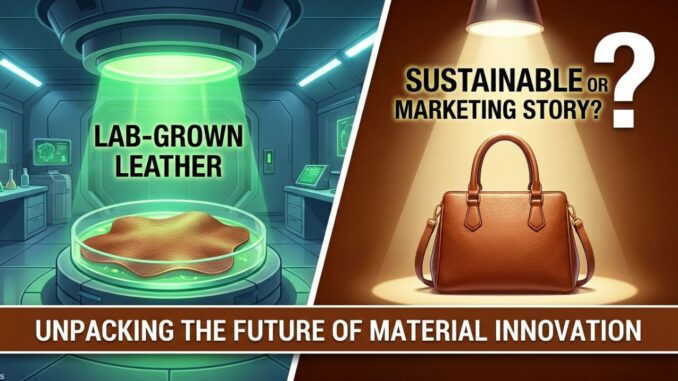
Leather has a sustainability problem that the fashion and goods industry has struggled to solve for decades. Traditional leather production is tied directly to the cattle industry, with all the land use, methane emissions, and water consumption that animal agriculture entails, and the tanning process itself uses chemicals, including chromium compounds, that create significant environmental hazards if not properly managed. For a luxury and fashion industry under increasing pressure from environmentally conscious consumers, finding a genuine alternative to animal leather has been a priority for years.
Lab-grown leather, in this context typically meaning mycelium-based leather alternatives produced by growing fungal networks into leather-like sheets, has emerged as the most prominent candidate. By 2025, mycelium leather had moved from science-fair curiosity to runway reality, with major luxury houses including Hermès and Stella McCartney incorporating mycelium-based materials into flagship products. The question this essay addresses is whether lab-grown leather represents a genuinely sustainable alternative to animal leather, with the evidence to support that claim, or whether it is a sophisticated marketing story that has outpaced the underlying environmental and commercial reality.
The Case For: The Sustainability Credentials Are Real
The fundamental environmental advantage of mycelium-based leather over animal leather is genuinely substantial and relatively easy to demonstrate. Unlike conventional leather production, which relies on raising and slaughtering cattle over a period of years, mycelium grows rapidly and can fully consume its growth substrate within weeks. This timeline difference alone represents an enormous reduction in the land use, water consumption, and methane emissions associated with cattle farming, which remains one of the most carbon-intensive forms of agriculture globally. A material that achieves leather-like properties through a few weeks of fungal growth on agricultural waste substrate, rather than years of animal husbandry, has a fundamentally different environmental profile before any other factor is considered.
The luxury fashion adoption that has occurred by 2025 represents genuine commercial validation, not just sustainability messaging. Stella McCartney, a pioneer in ethical fashion, collaborated with Bolt Threads to create Mylo, a mycelium-based material used in handbags and accessories. Hermès partnered with MycoWorks to launch a limited-edition version of its iconic Victoria bag, crafted from Reishi mycelium leather, a collaboration that placed mycelium leather literally inside one of the most recognised luxury brand names in the world. Adidas has experimented with plant-based and lab-grown alternatives for footwear lines. These are not small ethical fashion startups making aspirational claims. They are some of the most commercially significant fashion and luxury brands in the world, integrating mycelium materials into products that carry their brand reputation.
The material properties of mycelium leather have also matured significantly. Industrially produced mycelium-based leather alternatives from companies including MycoTech, MycoWorks, and Bolt Threads have demonstrated durability and fading resistance comparable to animal-derived leather, with the added benefit of heat resistance up to 250 degrees Celsius in some formulations. The aesthetic and tactile qualities that initially limited mycelium leather’s appeal in fashion applications have improved to the point where flagship luxury products are being built around the material rather than treating it as a token sustainability gesture.
The market data reflects this momentum. The global mycelium leather market was valued at approximately $16.48 million in 2024 and is projected to reach between $211 million and over $1 billion by the early 2030s, depending on the forecast methodology, representing a compound annual growth rate of roughly 45%. Around 37% of fashion brands have integrated mycelium leather into luxury and footwear segments according to recent industry surveys, and approximately 35% of US-based material science startups are investing in scalable mycelium leather production. This is not a niche curiosity attracting marginal interest. It is a material category attracting serious investment from established industry players.
The Case Against: The Scaling Failures Tell a Cautionary Story
The honest counter-narrative to the mycelium leather success story is that one of the most prominent and best-funded companies in the sector has already failed to scale production. Bolt Threads, the company behind Mylo and the Stella McCartney collaboration, announced in 2023 that it would be suspending Mylo production indefinitely. Bolt Threads was one of the highest-funded companies attempting to bring mycelium leather to mass production, and its inability to do so represents a significant cautionary signal about the gap between high-profile fashion collaborations and genuinely scalable manufacturing.
The Bolt Threads situation reveals a pattern that has recurred across multiple bio-based material categories: a high-profile luxury collaboration generates significant media attention and positions the material as a breakthrough, while the underlying production economics remain unresolved. A limited-edition Hermès bag made from mycelium leather is a powerful marketing statement and a genuine technical achievement, but it is not evidence that mycelium leather can be produced at the volume, consistency, and price point required to genuinely displace animal leather or synthetic leather alternatives across the mass market. Limited-edition luxury products, by definition, do not need to solve the scaling problem. Mass market products do.
MycoWorks, the company behind the Hermès collaboration, opened a new factory in South Carolina in September 2023 with claimed capacity to produce millions of square feet of material, and the industry has identified whether MycoWorks can successfully scale this production as a key test for the entire mycelium leather sector. As of the most recent industry analysis, this remains a live question rather than a resolved success. The difference between “has built a factory with claimed capacity” and “is consistently producing at that capacity with acceptable yield rates and quality consistency” is significant, and the history of bio-based material companies includes numerous examples of announced capacity that did not translate into sustained commercial-scale production.
There is also a definitional looseness in how “lab-grown leather” and “mycelium leather” are marketed that deserves scrutiny. Many commercial mycelium leather products are not pure mycelium. They typically combine a mycelium-grown base material with other components, including binders, coatings, and backing materials, some of which may themselves have less favourable environmental profiles than the marketing narrative suggests. The broader “bio-based leather” category, which includes mycelium leather alongside cactus-based, pineapple-fibre-based, and other plant-based alternatives, was valued at approximately $755 million globally in 2024, growing to a projected $1.43 billion by 2034. Within that broader category, the specific environmental credentials of any individual product depend heavily on its full composition, not just its headline ingredient, and full lifecycle environmental assessments comparing finished mycelium leather products to both animal leather and synthetic alternatives like polyurethane remain less common than the marketing narratives that accompany product launches.
What the Evidence Actually Shows
The evidence supports a conclusion that mycelium leather represents genuine technological and environmental progress in specific, currently limited applications, while the claim that it constitutes a broadly available sustainable alternative to animal leather remains ahead of the production reality for most of the market.
The core environmental case, that growing a material in weeks from agricultural waste has a fundamentally better footprint than years of cattle farming, is sound and not seriously disputed. The question is not whether mycelium leather is more sustainable than animal leather when both are produced at equivalent commercial scale. It is whether mycelium leather can actually be produced at that scale, with consistent quality, at a price point that allows it to compete in markets beyond ultra-premium luxury collaborations. The Bolt Threads suspension is direct evidence that this scaling challenge has defeated at least one well-funded, technically credible attempt. The MycoWorks factory represents an ongoing attempt to succeed where Bolt Threads did not, but as of the most recent reporting, its success remains unproven at full commercial scale.
The continued investment and brand adoption, including the 2025 mycelium leather “moment” in luxury fashion, suggests the industry has not given up on the category despite Bolt Threads’ setback. New entrants and continued investment from established players including Ecovative, Mycotech Lab, and others indicate that the technical challenges are seen as solvable rather than fundamental. But “seen as solvable by the industry” and “currently solved at commercial scale” are different claims, and the marketing narrative around mycelium leather in 2025 frequently elides this distinction.
The Verdict: Genuine Progress, Premature Triumphalism
Lab-grown leather, specifically mycelium-based leather alternatives, represents genuine and meaningful environmental progress in the specific applications where it has been successfully deployed: limited-edition luxury products, accessories, and footwear from brands willing to pay a premium for both the material and the sustainability story it tells. In these applications, the environmental case is sound, the material performance has matured to genuinely impressive levels, and the brand adoption by names including Hermès represents real commercial validation of the material’s quality and appeal.
The claim that mycelium leather is “truly sustainable” as a broad, mass-market alternative to animal leather is not yet supported by the production evidence. Bolt Threads’ suspension of Mylo production is the clearest available evidence that the gap between high-profile collaboration and scalable manufacturing remains unresolved for at least one major player, and MycoWorks’ attempt to succeed where Bolt Threads did not is an ongoing test rather than a settled success. The growth projections for the mycelium leather market, while impressive in percentage terms, start from a tiny base, $16.48 million in 2024, that reflects the current reality: a category still operating primarily in premium and limited-edition applications rather than displacing animal leather across the volumes that would constitute a genuinely transformative shift.
The honest framing is that mycelium leather is a sophisticated marketing story built on a genuine technological foundation, with the marketing currently running ahead of the manufacturing. That is not the same as saying it is dishonest. The environmental science is sound, the luxury fashion partnerships are real, and the trajectory of investment and brand adoption suggests continued progress. But anyone evaluating claims about mycelium leather’s role in solving the sustainability problems of the leather industry should distinguish carefully between what has been demonstrated in limited-edition luxury collaborations and what has been demonstrated at the production scale required to meaningfully reduce the environmental footprint of the global leather industry. As of 2025, that gap remains the central unresolved question, and the answer to it will determine whether mycelium leather becomes a footnote in fashion history or a genuine replacement for one of the most environmentally costly materials in the consumer goods industry. The same scaling question runs through the parallel debate over whether mycelium-based biomaterials can realistically replace single-use plastics in packaging, where similar production economics determine the realistic ceiling for adoption. The pattern of genuine scientific progress paired with overconfident timelines also defines the debate over whether bioprinted organs could eliminate the global transplant waiting list by 2040, where real breakthroughs in tissue engineering coexist with a gap between laboratory demonstrations and clinical-scale reality.
Leave a Reply