
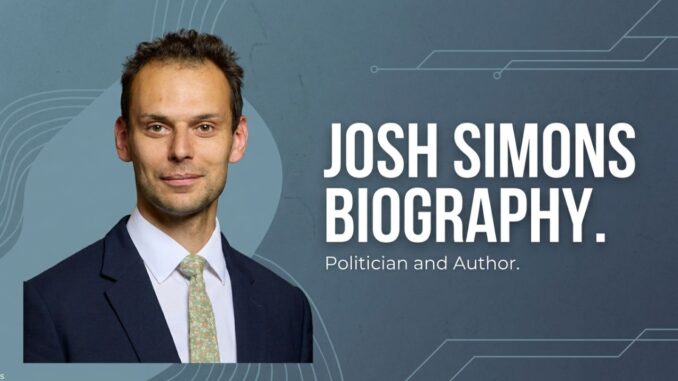
Joshua Cameron Simons was born on 24 July 1993 in Cambridge, England. He is a British politician and former Labour Member of Parliament for Makerfield, known for his academic background in artificial intelligence policy and his decisive role in the 2026 Labour leadership crisis.
In May 2026, Simons resigned his parliamentary seat to trigger a by-election, clearing the path for Andy Burnham to return to Westminster and launch a Labour leadership bid. This biography covers his early life, education, career in politics and technology, personal life, and the resignation that reshaped British politics.
Quick Facts About Josh Simons
| Full Name | Joshua Cameron Simons |
| Date of Birth | 24 July 1993 |
| Age | 32 as of 2026 |
| Place of Birth | Cambridge, England |
| Nationality | British |
| Occupation | Former Labour MP for Makerfield, author and policy expert |
| Net Worth | Not publicly disclosed |
| Spouse/Partner | Name not publicly confirmed; met at Harvard University |
| Education | St John’s College, Cambridge (BA Social and Political Sciences); Harvard University (PhD Government) |
| Social Media | @joshsimonsmp on X (Twitter) |
Early Life and Education
Josh Simons was born on 24 July 1993 and grew up in Cambridge. His father was Jewish and originally from Bury, Greater Manchester, a city that would later play a significant role in his political life. He attended The Perse School in Cambridge, an independent school known for its academic rigour, before earning a place at one of the country’s most prestigious universities.
At St John’s College, Cambridge, Simons studied Social and Political Sciences, graduating with a Bachelor of Arts and finishing top of his year. During his time at Cambridge he edited two student newspapers, Varsity and The Tab, sharpening the writing and editorial skills that would later define his public voice. He was also a contributor to the student political scene, engaging with ideas about democracy, technology, and public policy from an early age.
After graduating from Cambridge, Simons briefly worked as a research assistant to the Nobel Prize-winning economist Amartya Sen before joining the Institute for Public Policy Research in 2015. That same year he became a policy adviser to Jeremy Corbyn following Corbyn’s election as Labour leader, placing himself at the centre of British left politics before the age of 25.
Simons later completed a doctorate in Government, Political Theory and Political Science at Harvard University’s Kennedy School. It was at Harvard that he met his wife, and the two went on to have children together. His doctoral research focused on the politics of statistics and data-driven decision-making, work he later adapted into his book, Algorithms for the People: Democracy in the Age of AI. He also held a postdoctoral fellowship at Harvard and served as a fellow at the Edmond J. Safra Centre for Ethics and the Berkman Klein Centre for Internet and Society.
Career and Professional Life
Josh Simons built his career across three distinct worlds: political activism, academic research, and the technology industry. Each chapter informed the next, producing a politician with an unusually deep command of both digital policy and grassroots Labour strategy.
His time in Jeremy Corbyn’s office began in 2015, where he served as a policy adviser. Despite this role, Simons resigned from the Leader’s Office over concerns about antisemitism within the Labour Party under Corbyn. He was among the earliest and most prominent whistleblowers on the issue, contributing to the Equality and Human Rights Commission’s landmark investigation into Labour antisemitism. The experience shaped his political identity and his later commitment to rooting out prejudice within progressive movements.
Between 2018 and 2022, Simons worked at Meta as a Visiting Research Scientist within its artificial intelligence programme. He has since stated that during this period he repeatedly raised concerns with company leadership about the addictive risks of Meta’s platforms, particularly their effects on children. In 2025 he was subpoenaed in multi-district litigation against Meta over social media harms. In 2026, two separate American juries found that Meta had knowingly designed addictive products that harmed young users, including in the California case for which Simons had been deposed. His insider knowledge of the tech industry’s worst practices gave him credibility on digital policy that few British politicians could match.
After returning to the UK from Harvard, Simons worked briefly for London Labour before joining the Civic Power Fund, an organisation dedicated to community organising. In 2022 he became director of Labour Together, a centrist Labour-aligned think tank closely associated with Keir Starmer’s leadership. He built the organisation into one of the most influential policy shops on the British left, working alongside Labour’s leadership to develop plans ahead of the 2024 general election. He is also a co-founder and co-chair of the Labour Growth Group, a parliamentary group focused on economic growth and public investment.
Simons was elected as the Labour Member of Parliament for Makerfield at the 2024 general election, selected by Labour’s National Executive Committee several weeks before the vote after the incumbent MP Yvonne Fovargue announced she would not stand again. He took the seat with a majority of 5,399 over Reform UK. In September 2025 he was appointed Parliamentary Secretary in the Cabinet Office, and in January 2026 he was additionally appointed Parliamentary Under-Secretary of State for Digital Government, giving him ministerial responsibility over the government’s most technically complex portfolio.
The Labour Together Scandal and Ministerial Resignation
In early 2026, a significant controversy emerged around Simons’ time as director of Labour Together. Reports revealed that the PR firm APCO Worldwide had been commissioned by Labour Together to investigate the private backgrounds of several journalists who had written articles unfavourable to the think tank. The investigation, codenamed Operation Cannon, was written by a former Sunday Times employee and falsely suggested that two Sunday Times journalists were part of a Russian influence campaign targeting Keir Starmer.
A shorter version of the APCO report was sent to GCHQ’s National Cyber Security Centre, which declined to investigate. The Sunday Times published the findings, and Prime Minister Starmer asked his Independent Adviser on Ministerial Standards, Sir Laurie Magnus, to investigate whether Simons had breached the Ministerial Code.
On 28 February 2026, Simons resigned from all his ministerial positions. In his resignation letter, he acknowledged the damage the revelations had caused and praised the journalists involved for holding power to account. Sir Laurie Magnus concluded that while Simons had not clearly breached the Ministerial Code, his conduct had caused “potential reputational damage” to the Labour Party. Despite this qualified exoneration, Simons chose not to return to government.
Personal Life
Josh Simons met his wife while studying at Harvard University. The couple have children together and at the time of his resignation had settled in the Wigan area to serve the Makerfield constituency. Simons has spoken openly about the role his family played in his decision to stand down as an MP in May 2026, describing the choice as one made together as a family unit.
His wife’s name has not been confirmed in public sources. Simons has been careful to keep his family life out of the media spotlight, though he has referenced his wife and children in interviews. He has Jewish heritage on his father’s side and has been vocal throughout his career about the importance of tackling antisemitism in public life.
Outside politics, Simons is known as a serious intellectual. His book Algorithms for the People: Democracy in the Age of AI brought his doctoral research to a wider audience and established him as a credible voice on technology governance. He also co-founded Arguably, a Substack publication focused on progressive political ideas and philosophy, alongside collaborator Cam Vargas.
Simons maintains an active presence on social media under the handle @joshsimonsmp on X (formerly Twitter), and ran a Facebook page under JoshSimonsMP. He was known during his time as an MP for using digital platforms more confidently than most of his parliamentary colleagues, consistent with his background in technology policy.
Josh Simons and the Makerfield Resignation That Changed British Politics
The decision that elevated Josh Simons from a minor political footnote to a figure of genuine historical significance came in May 2026. Following devastating Labour losses in the local elections, Simons was among the Labour MPs calling publicly for Keir Starmer to step down and begin an orderly transition of leadership. He believed the party needed urgent, radical change to reconnect with the communities it had been built to serve.
Simons chose to act rather than simply speak. On 14 May 2026, he announced that he would resign his seat as MP for Makerfield, triggering a by-election that would allow Andy Burnham, the Mayor of Greater Manchester, to stand for Parliament. Without a parliamentary seat, Burnham could not challenge for the Labour leadership. With it, he could. Simons’ resignation was therefore not merely a political gesture but a structural intervention that opened a direct route to a change in prime minister.
His resignation was formalised on 18 May 2026, when he was appointed Crown Steward and Bailiff of the Chiltern Hundreds, an archaic ceremonial office that legally disqualifies its holder from sitting in the House of Commons. The writ for the by-election was moved the following day, with the vote set for 18 June 2026. Burnham was confirmed as Labour’s candidate after no other names were submitted, bypassing the local party’s usual selection process.
Andy Burnham won the Makerfield by-election on 18 June 2026 with 54.8 percent of the vote and a majority of 9,231, far exceeding expectations. Turnout was 58.8 percent, the highest for any parliamentary by-election since Brecon and Radnorshire in 2019. Four days later, Keir Starmer announced his resignation as Prime Minister and Labour leader. As of late June 2026, Burnham is the sole declared candidate in the Labour leadership election and is widely expected to become the next leader of the party and, in time, Prime Minister. The chain of events that made this possible began with Josh Simons’ decision to give up his seat.
Simons explained the personal dimension of the decision in media appearances. He said: “It wasn’t just me, it was my wife. We did this as a family, because it’s about the sacrifices on behalf of the family.” He insisted there were no side deals involved, no arrangement to run for mayor or a seat in the Lords. He said his sole concern was whether Burnham could genuinely deliver the change the country needed. He added that sometimes doing the right thing for your community and country means acting against your own personal interest, and that he would not have resigned unless he truly believed it was the right thing to do.
Political historians are already noting that Simons’ resignation represents the first time since the 1965 Leyton by-election that a sitting MP stepped down specifically to create a vacancy for a politician not currently in Parliament. It was a calculated, deliberate act of political self-sacrifice that may prove to be among the most consequential single decisions made by any backbench MP in recent British history.
You can also read more about UK political biographies including our profile of Dan Jarvis, whose leadership campaign was made possible by Simons’ resignation.
Leave a Reply