
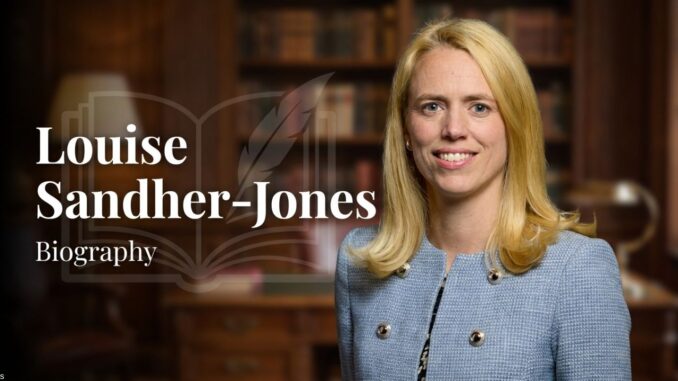
Louise Elizabeth Sandher-Jones was born in 1989 or 1990 and grew up in Leicestershire, England. She is a British Labour politician, former British Army Intelligence Corps officer, and the current Parliamentary Under-Secretary of State for the Armed Forces, appointed in June 2026 following the defence ministerial reshuffle triggered by the resignations of John Healey and Al Carns. She is the Member of Parliament for North East Derbyshire since 2024.
Her biography is unusually varied for a politician still in her mid-thirties: she has worked in the Civil Service, the Army, Morgan Stanley, an insurtech company, and now government. This biography traces all three phases of that career and how each one built the foundations for the role she holds today.
Quick Facts About Louise Sandher-Jones
| Full Name | Louise Elizabeth Sandher-Jones |
| Date of Birth | 1989 or 1990 (exact date not publicly confirmed) |
| Age | 35 or 36 as of 2026 |
| Place of Birth | Leicestershire, England |
| Nationality | British |
| Occupation | Parliamentary Under-Secretary of State for the Armed Forces; Labour MP for North East Derbyshire |
| Net Worth | Not publicly disclosed |
| Spouse/Partner | Jeevun Sandher (married August 2025) |
| Education | University of Edinburgh (Chinese); Ocean University of China (year abroad); Royal Military Academy Sandhurst |
| Military Service | British Army Intelligence Corps, Second Lieutenant to officer rank; deployed to Afghanistan |
| Languages | English and Mandarin Chinese |
| Social Media | No widely confirmed public social media handle |
Early Life and Education
Louise Sandher-Jones grew up in Leicestershire. She studied Chinese at the University of Edinburgh, an unusually demanding language choice that reflects both intellectual ambition and an early interest in international affairs. During her degree she spent a year abroad at Ocean University of China, developing genuine Mandarin language skills at one of China’s leading coastal universities. The linguistic and cultural grounding she gained during that year abroad would prove relevant throughout a career in intelligence, security, and international policy.
After graduating, she joined the Civil Service graduate scheme, a competitive programme that recruits high-calibre graduates into fast-track roles across government departments. She remained in the Civil Service briefly before making the decision to join the British Army.
Phase One: Military Career in the Intelligence Corps
Louise Sandher-Jones joined the British Army in 2013. She attended the Royal Military Academy Sandhurst and was commissioned as a Second Lieutenant in the Intelligence Corps on 12 April 2014. The Intelligence Corps is one of the most selective branches of the British Army, responsible for gathering, processing, and analysing intelligence to support military operations. Officers are required to combine analytical rigour with the ability to operate in high-pressure and frequently dangerous environments.
She was based at postings in Germany and the United Kingdom during her service and deployed on operations to Afghanistan, serving during the final phase of British military engagement there. Her time in Afghanistan gave her direct operational experience of one of the most complex and demanding theatres of modern conflict, experience she has since drawn on in her parliamentary and ministerial work on veterans policy, defence readiness, and the Armed Forces Bill.
She left the Army in 2020 after seven years of service. The transition from military life to civilian career is a path many former officers navigate carefully, and Sandher-Jones chose two very different sectors for the next chapter: finance and intelligence technology.
Phase Two: Finance, Intelligence Technology and the Private Sector
After leaving the Army, Sandher-Jones joined Morgan Stanley as an associate. Morgan Stanley is one of the world’s leading investment banks, and an associate role there is a competitive position that requires analytical capability and the ability to manage complex information under pressure. Skills she had developed in military intelligence translated directly into the demands of financial analysis, and the role demonstrated her capacity to operate in environments very different from military service.
In July 2021 she joined McKenzie Intelligence Services as Head of Intelligence. McKenzie Intelligence is a specialist company in the insurtech sector, focused on analysing the impact of natural disasters using satellite imagery and geospatial data to support the global insurance industry. As Head of Intelligence she led the company’s core analytical function before moving into a senior management role focused on product development. The combination of her military intelligence background, her analytical skills from Morgan Stanley, and her ability to translate complex data into actionable insight made her a natural fit for a company operating at the intersection of data science, risk, and international events.
During this period she also served as a councillor for the Loughborough East ward on Charnwood Borough Council, her first elected office, combining local politics with her private sector career. She resigned from the council role in March 2024 after being selected as the prospective parliamentary candidate for North East Derbyshire.
Phase Three: Parliament and the Ministry of Defence
Louise Sandher-Jones was elected as the Labour Member of Parliament for North East Derbyshire at the 2024 general election, defeating the Conservative incumbent Lee Rowley with a majority of 1,753 votes, a 3.9 percent margin. She made her maiden speech in the House of Commons on 8 October 2024.
In September 2025, Prime Minister Keir Starmer appointed her Parliamentary Under-Secretary of State for Veterans and People at the Ministry of Defence, a role created to focus on the welfare, housing, healthcare and career transition support of serving and former personnel. Her combination of combat deployment experience, intelligence officer background, and private sector engagement with national security gave her immediate credibility in a brief that requires both empathy for veterans and command of complex policy.
In June 2026, following the resignations of Defence Secretary John Healey and Armed Forces Minister Al Carns, she was promoted to Parliamentary Under-Secretary of State for the Armed Forces, the more senior of the two roles. As Forces News reported, she took over responsibility for legislation including the Armed Forces Bill, support for Ukraine, and autonomy and drones policy including the Drone Centre of Excellence. She was the first woman to hold the Armed Forces Minister role in this parliament, a fact that received surprisingly limited coverage given its significance.
Her appointment completed a remarkable reshuffle in which the Ministry of Defence lost its two most senior ministers and replaced them with two MPs who both had direct personal military service. The reshuffle was described in detail in the coverage of her colleague Al Carns, whose resignation directly triggered her promotion.
Personal Life
Louise Sandher-Jones is married to Jeevun Sandher, whose surname she has combined with her own to form the double-barrelled name she uses both publicly and officially. The couple married in August 2025, with friends, family and colleagues attending what was described as a beautiful ceremony. She enjoys walking in the Peak District with her dog, Nugget, a detail that speaks to someone who, despite a CV that takes in Sandhurst, Morgan Stanley, Kabul and Westminster, has put down roots in the Derbyshire landscape she now represents.
She has maintained a relatively low personal media profile, consistent with both her Intelligence Corps background and the general culture of discretion that surrounds the Ministry of Defence. Her public statements focus consistently on policy substance, veterans welfare, and defence capability, rather than on personality or personal narrative. Within Westminster, she is regarded as a precise and well-briefed operator who brings genuine operational credibility to a portfolio that is often held by career politicians with no direct military experience.
In the broader context of the 2026 UK defence reshuffle, her biography sits alongside those of Dan Jarvis and Al Carns as one of three consecutive Armed Forces Ministers with direct personal service in the British military, an unusual concentration of operational experience at the top of the Ministry of Defence.
Conclusion
Louise Sandher-Jones entered Parliament as one of the least well-known faces in a large intake of Labour MPs, with no national profile and a wafer-thin majority. Within two years she had become a minister at the Ministry of Defence, then been promoted to one of the most demanding junior roles in government during a period of significant military and political turbulence. What makes her career compelling is not just the speed of the ascent, but the depth of the foundation beneath it: seven years in Army intelligence, deployments in Afghanistan, private sector work in financial analysis and disaster risk, fluency in Mandarin, and elected office at both local and national level. She arrived at the Armed Forces Minister role with more relevant real-world experience than most people who have ever held it. Whether that experience shapes a lasting political career is the question her next few years will answer.
For more profiles from the 2026 UK political and defence landscape, visit our United Kingdom biography section.
Leave a Reply