
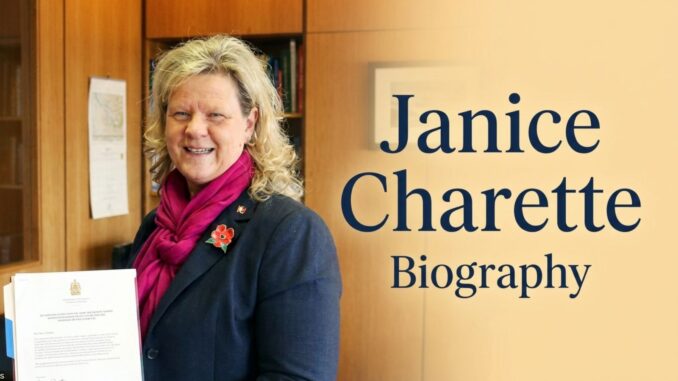
Janice Charette was born in 1963 and grew up in Ottawa, Ontario, Canada. She is a Canadian public servant, diplomat, and the Honourable Janice Charette, appointed by Prime Minister Mark Carney on 16 February 2026 as Canada’s Chief Trade Negotiator to the United States. She is 63 years old, has spent four decades at the highest levels of the Canadian federal government, and arrived at this role carrying a career that includes two separate tenures as Clerk of the Privy Council, five years as Canada’s High Commissioner to the United Kingdom, and a front-row seat at every major crisis that tested the Canadian state between 2014 and 2023.
She is married to Reg Charette and they have two adult children. This biography covers her career, the context of her appointment, and why she is considered one of the most capable public servants Canada has produced in a generation.
Quick Facts About Janice Charette
| Full Name | The Honourable Janice Charette PC OC |
| Date of Birth | 1963 (exact date not publicly confirmed) |
| Age | 63 as of 2026 |
| Place of Birth | Ottawa, Ontario, Canada |
| Nationality | Canadian |
| Occupation | Canada’s Chief Trade Negotiator to the United States (appointed February 2026) |
| Net Worth | Not publicly disclosed |
| Husband | Reg Charette |
| Children | Two adult children |
| Education | Bachelor of Commerce (Honours), Carleton University (1984); Honorary Doctor of Laws, Carleton University (2023) |
| Honours | Officer of the Order of Canada (December 2025); Privy Councillor |
| Social Media | No widely confirmed public social media handle |
The Clock on the Wall: Why This Appointment Matters
On 1 July 2026, the formal review period of the Canada-United States-Mexico Agreement begins. The CUSMA, known as the USMCA in the United States, is the trade framework governing the largest bilateral trading relationship in the world. More than 800 billion Canadian dollars in goods and services cross the Canada-US border every year. Under President Donald Trump’s second administration, the United States has imposed sweeping tariffs on Canadian goods, threatened to dissolve the trilateral agreement, and applied pressure across virtually every sector of the Canadian economy. The review is not a routine diplomatic exercise. It is, in the words of one trade analyst, “probably the most important negotiation this country has faced in a long time.”
Prime Minister Carney needed someone who could walk into that room without needing briefings on the basics, someone who had already spent years dealing with Washington, with trade, with crisis, and with the machinery of government at its most under pressure. He chose Janice Charette. The appointment was announced on 16 February 2026, and the stakes attached to it have only grown in the months since.
Early Life and Education
Janice Charette was born and raised in Ottawa, the city that would become the permanent backdrop to her professional life. She studied at Carleton University, graduating with a Bachelor of Commerce with Honours in 1984, the same year she joined the federal public service. Carleton later awarded her an honorary Doctor of Laws in 2023, recognising the extraordinary career she had built across the four decades since her graduation. She also serves on the advisory board of Carleton’s School of Policy Studies and on the board of the Institute for Research on Public Policy, maintaining an active relationship with the academic institutions that shaped her early thinking.
Four Decades in the Canadian Public Service
Janice Charette joined the Department of Finance in 1984 and spent the next four decades building a career of remarkable breadth across the federal public service. She held senior roles across eight departments covering skills development, labour markets, immigration, citizenship, social security, health, justice, and intergovernmental affairs. She served as a policy analyst, a senior departmental assistant to the Minister of Finance, and as Senior Policy Adviser in the Federal-Provincial Relations Office. By the time she reached the most senior position available to a Canadian public servant, she had accumulated policy experience across virtually every major domestic portfolio.
She was appointed Clerk of the Privy Council and Secretary to the Cabinet on 20 August 2014 by Prime Minister Stephen Harper, becoming only the second woman to hold that post. The Clerk of the Privy Council is simultaneously the head of the public service, the principal policy adviser to the Prime Minister, and the secretary to the Cabinet. It is, without question, the most powerful unelected position in the Canadian government. She held it until 22 January 2016, when she was replaced by Michael Wernick under the new Trudeau government.
Rather than fading into retirement or the private sector, Charette was appointed Canadian High Commissioner to the United Kingdom on 19 July 2016. She served in London until March 2021, overseeing Canada’s relationship with the UK through the entire chaotic period of Brexit, which reshaped British trade policy, threatened the Canada-UK Comprehensive Economic and Trade Agreement, and demanded constant diplomatic attention. Her post-Brexit period management was later cited as a significant asset for her CUSMA role: she understands how trade frameworks unravel under political pressure, and how to hold them together.
In March 2021, Prime Minister Trudeau recalled her as Interim Clerk of the Privy Council while the then-current Clerk Ian Shugart underwent cancer treatment. She was permanently reappointed to the Clerkship on 25 May 2022 and held it until her retirement in June 2023. Her second tenure as Clerk encompassed the “Freedom Convoy” protests and the invocation of the Emergencies Act, Russia’s invasion of Ukraine and Canada’s response, a two-week public service strike, and growing evidence of foreign interference by China and India in Canadian political life. Trudeau later said at the Public Order Emergency Commission that Charette’s formal recommendation to invoke the Emergencies Act was “essential” to his decision to proceed. She is a Privy Councillor and was named an Officer of the Order of Canada in December 2025.
Chief Trade Negotiator: The Current Role
Charette came out of retirement in February 2026 at Carney’s request to take on the Chief Trade Negotiator role, having also led Carney’s transition team after he won the Liberal leadership race and became Prime Minister. She works closely with Canada-US Trade Minister Dominic LeBlanc and Canada’s Ambassador in Washington, Mark Wiseman. Wiseman’s role is primarily representational and relationship-based. Charette’s is strategic: she directs the negotiating posture, establishes Canada’s limits and red lines, coordinates across government departments, and reports directly to the Prime Minister.
Those who have worked with her describe a consistent pattern. She listens widely before deciding. She remains calm under pressure. She is direct when she needs to be, and tough when the situation demands it. Brian Clow, the Canada-US relations lead under Justin Trudeau, described her to the Globe and Mail as “smart, thoughtful and incredibly diligent” and added “she can also be tough when she needs to be.” Jason Kenney, the former Conservative minister and Alberta premier, described her publicly as “no nonsense, results-oriented, highly trusted.” The fact that two men from opposite sides of the political spectrum offered near-identical assessments says something important about how she is perceived across the partisan divide.
She has spoken publicly about her approach to the current moment. Before her appointment, in a webinar held in March 2025, she described the tariff situation as “the big door” Canada needed to get through: “If we’re able to get through the tariff door then I think, actually, we can have extremely productive and extremely constructive conversations around a whole host of areas where we have shared interests.” Getting through that door by 1 July 2026 is the task her name is now attached to. Another Canadian figure navigating the diplomatic complexities of 2026 is profiled in our piece on Tarun Bali, the OPP Constable from Brampton whose death in the line of duty in June 2026 drew tributes from Canada’s federal leadership including the Public Safety Minister.
Personal Life
Janice Charette is married to Reg Charette. They have two adult children. She has maintained a personal life largely separate from her public profile, consistent with the tradition of the senior civil service in Canada. She is a member of the board of directors of the Royal Ottawa Healthcare Group and of the advisory board of Carleton’s School of Policy Studies. She has spoken at conferences on mental health in the workplace, reflecting a sustained interest in organisational culture and the wellbeing of public servants who operate under sustained pressure. She was awarded the Order of Canada in December 2025 for her service to the country across four decades of public life.
Conclusion
Janice Charette has spent forty-two years in Canadian public life, and she came out of retirement for the most consequential negotiation of her career. That tells you something about the task she has been given, and something about the person who accepted it. She has navigated the Freedom Convoy, Brexit, the Syrian refugee crisis, the Trans-Pacific Partnership, foreign interference, and a public service strike. She dined at Windsor Castle and told a Prime Minister that a Queen had died. She has done all of it with a reputation that crosses party lines and is described in almost identical terms by people who agree on very little else. What she does with the CUSMA review will define the final chapter of a career that has already been extraordinary.
Leave a Reply