
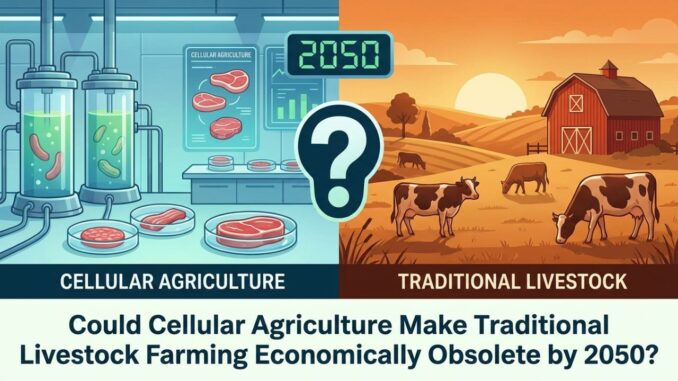
The global livestock farming industry is one of the largest and most environmentally consequential sectors in the world economy. It occupies roughly 80% of agricultural land, contributes approximately 14.5% of global greenhouse gas emissions, uses vast quantities of fresh water, and generates significant animal welfare concerns at a scale of tens of billions of animals slaughtered annually. The case for disrupting it is, on environmental and ethical grounds, compelling. Cellular agriculture, the production of meat and other animal products directly from animal cells without raising or slaughtering animals, has been proposed as the technology that could make traditional livestock farming economically obsolete within a generation.
The ambition is not modest. A 2019 report by think tank RethinkX claimed that by 2030 the US meat and dairy industries would be effectively bankrupt due to cellular agriculture displacing their markets. That prediction, as of 2025, has not materialised. But the more measured 2050 timeline, the question this essay directly addresses, deserves a rigorous examination of what the evidence actually supports rather than what the most optimistic or most sceptical voices in the debate claim.
The Case For: The Technology and Market Forces Are Real
The scale of investment flowing into cellular agriculture in the decade to 2025 is substantial, and it has produced genuine scientific progress. Research publications on cultivated meat increased from 28 before 2015 to 125 in 2020 and 647 by 2024, with 190 articles presenting new primary data in 2024 alone. The first quarter of 2025 had already seen 71 articles, of which 27 presented new data. This is not a field producing more marketing than science. It is a field generating an accelerating volume of peer-reviewed research across cell biology, tissue engineering, fermentation technology, bioprocess engineering, and food science. The scientific infrastructure for cellular agriculture is being built in parallel with the commercial development, which is the profile of a technology approaching scale rather than stalling at the prototype stage.
The global cellular agriculture market was valued at approximately $7 billion in 2024 and is projected to reach $46.5 billion by 2034. The broader lab-grown meat market is projected by some analysts to reach $229 billion by 2050, with a compound annual growth rate of 30.8%. These are not figures generated by a single optimistic forecast. They reflect a range of independent market analyses that consistently project substantial growth over a multi-decade horizon. The global meat market is valued at over $1 trillion annually, and even capturing a relatively modest share of that market represents a transformative commercial outcome for the cellular agriculture sector. Companies including GOOD Meat, UPSIDE Foods, and Vow are actively scaling production, and regulatory approvals, including the US FDA and USDA clearance of GOOD Meat and UPSIDE Foods chicken for sale in the US market, demonstrate that the pathway from laboratory to commercial sale has been successfully navigated in at least one major market.
The environmental argument for disruption is also gaining economic weight. ESG investment pressure on the livestock sector, combined with increasingly stringent emissions regulations in the EU and growing carbon pricing mechanisms globally, means that the true cost of conventional livestock farming is becoming progressively more visible in financial terms. As carbon costs are increasingly internalised, the cost advantage of conventional meat over cultivated meat narrows even before cellular agriculture achieves full technical cost parity. Regulatory pressure on land use, water use, and antibiotic use in livestock farming adds further economic headwinds to the conventional sector, creating a competitive environment that is becoming structurally less favourable to incumbent livestock production.
The Case Against: Why 2050 Is Still an Optimistic Timeline
The honest counterargument begins with the gap between the 2019 RethinkX prediction of 2030 industry disruption and the actual 2025 reality, where cultivated meat remains a tiny fraction of total meat consumption in every market, even those with regulatory approval. If a prediction of disruption by 2030 was wrong by a substantial margin even after years of substantial investment, a prediction of disruption by 2050 requires careful scrutiny rather than confident acceptance.
The cost challenge in cellular agriculture has proved more persistent than early projections suggested. Production costs have fallen dramatically since the first lab-grown burger cost over $300,000 in 2013, but the trajectory of cost reduction has slowed as the easy gains from basic process optimisation were captured. The remaining cost challenges are more fundamental. Growth media for cell cultivation, particularly the components that provide essential nutrients to growing cells, remain expensive. Achieving the structural complexity of whole-muscle meat, with the intramuscular fat distribution, texture, and fibre alignment that makes conventional meat culinarily appealing, requires bioprinting or scaffolding approaches that add cost and manufacturing complexity. And the scale of bioreactor infrastructure required to produce cultivated meat at volumes that genuinely compete with conventional meat production, even for a meaningful fraction of global demand, would represent a capital investment that has not yet been demonstrated or funded.
Investment momentum, which had been a positive signal through 2023, slowed significantly in 2024 and 2025 due to concerns over cost efficiency, regulatory complexity, and consumer scepticism. This funding slowdown is particularly significant because the capital intensity of scaling cellular agriculture production means that any sustained period of reduced investment directly delays the cost reduction trajectory. The compounding growth of research publications and the improving scientific toolkit are genuinely positive signals, but they do not automatically translate into commercial-scale production economics improving at the pace required to make conventional livestock farming economically obsolete by 2050.
There are also equity and structural arguments against treating cellular agriculture as an inevitable replacement for traditional livestock farming on a global scale. Livestock farming is not only a source of meat for high-income consumers in wealthy countries. For approximately 1.3 billion people globally, livestock are integral to livelihoods, cultural identity, and subsistence food security. The ecosystem services provided by livestock, including soil fertility through manure, draught power for smallholder farming, and the conversion of non-arable land into human-consumable protein, are not replicated by cellular agriculture. Making traditional livestock farming economically obsolete in the sense of undermining its commercial viability in developing world contexts would have severe consequences for food security and rural livelihoods in regions where cellular agriculture is not an accessible alternative, raising equity concerns that a purely technology-optimist framing ignores.
What the Evidence Supports
The evidence supports a conclusion that cellular agriculture will become an economically significant part of the protein supply chain by 2050 in high-income markets, without making traditional livestock farming globally obsolete in the full sense of that phrase.
The accelerating pace of scientific publication, the demonstrated regulatory pathways in the US and Singapore, and the sustained market projections all point toward cellular agriculture establishing a genuine commercial presence in the coming decades. The environmental pressures on conventional livestock farming are real and growing, and the combination of carbon pricing, land use regulation, and consumer preference shifts will progressively improve the competitive position of cultivated meat even before full technical cost parity is achieved.
But “economically significant” and “economically obsolete conventional livestock farming” are very different claims. The livestock sector serves needs, particularly in lower-income countries and subsistence farming contexts, that cellular agriculture cannot replicate at accessible cost points within the 2050 timeframe suggested by current technology trajectories. Even in high-income markets, the conventional meat sector has proven more resilient to alternative protein disruption than early projections suggested, with plant-based meat experiencing significant market share reversal in 2022 to 2024 after years of optimistic growth projections. Cellular agriculture faces a more favourable technical position than plant-based meat in terms of product fidelity to conventional meat, but it faces similar consumer adoption challenges and substantially greater production cost challenges.
The Verdict: Significant Disruption, Not Obsolescence, by 2050
Cellular agriculture will not make traditional livestock farming economically obsolete by 2050. The cost barriers, the capital investment requirements for production at meaningful scale, the equity implications for livestock-dependent communities in the developing world, and the demonstrated resilience of conventional meat consumption in the face of alternative protein competition all make the obsolescence framing unrealistic within this timeframe.
What is realistic by 2050 is substantial disruption in specific market segments: high-income urban consumers in markets with regulatory approval and developed cold chain and retail infrastructure, foodservice and food manufacturing applications where consistent, programmable protein characteristics offer genuine production advantages, and premium meat products where the provenance and welfare credentials of cellular agriculture can command a price premium. Within those segments, cellular agriculture could capture a meaningful market share, perhaps somewhere between 10% and 30% of total meat consumption in leading markets by mid-century, representing a commercially significant but not sector-destroying competitive challenge to conventional livestock farming.
For the question to be answered differently, one of two things would need to happen: either a fundamental breakthrough in production cost reduction that brings cultivated meat to price parity with conventional meat at scale far sooner than current projections suggest, or a regulatory or environmental shock to conventional livestock farming, such as a carbon tax or land use restriction severe enough to substantially increase the cost of conventional meat production, that changes the competitive dynamic before cellular agriculture has independently solved its own cost challenges. Neither is impossible, but neither is currently supported by the evidence as the most likely trajectory. The same gap between ambitious projection and realistic timeline characterises the lab-grown food landscape more broadly, from whether lab-grown pet food can replace conventional meat diets within a decade to whether cellular agriculture will transform the human food system within a generation.
Leave a Reply