
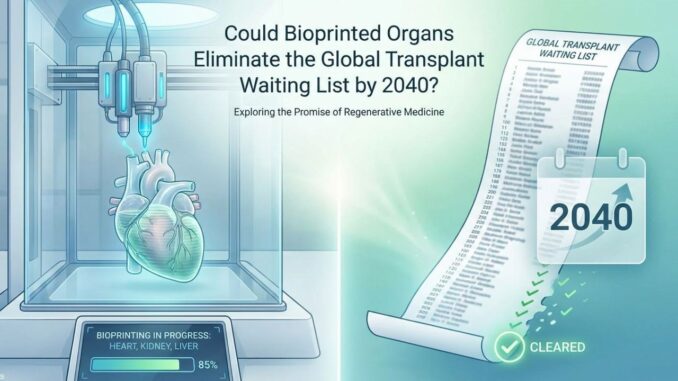
The global organ transplant shortage is one of the most persistent and lethal supply problems in modern medicine. In the United States alone, more than 100,000 people sit on organ transplant waiting lists at any given time, and an estimated thirteen to seventeen people die every day while waiting for an organ that never arrives. The mismatch between organ demand and donor supply has remained essentially intractable for decades, despite improvements in donor registration, allocation algorithms, and surgical technique. The fundamental constraint, that organs come from human donors, living or deceased, has not changed.
Bioprinted organs, produced by layering living cells, hydrogels, and growth factors using specialised 3D printers to recreate the structure of human tissue, have been proposed as a potential end to this shortage. The premise is compelling: if organs can be printed on demand using a patient’s own cells, the donor supply constraint disappears entirely, transplant rejection becomes far less likely, and waiting lists become obsolete. The question this essay addresses is whether bioprinted organs could realistically eliminate the global transplant waiting list by 2040, a fifteen-year horizon from the most recent major developments in the field.
The Case For: The Pace of Progress Is Genuinely Accelerating
The most significant recent development in organ bioprinting is the scale of institutional commitment now flowing into the field. In early 2026, UT Southwestern Medical Center won a $25 million federal award to lead a project bioprinting human organs, building on two decades of progress in biomaterials, stem cell differentiation, and bioprinting technology. This followed the Advanced Research Projects Agency for Health’s 2024 launch of the PRINT programme, the Personalized Regenerative Immunocompetent Nanotechnology Tissue initiative, which is explicitly focused on bioprinting personalised, on-demand organs that would not require lifelong immunosuppressive drugs, starting with kidneys, livers, and hearts, the three organ types with the longest waiting lists.
The technical milestones achieved across different organ systems by 2024 and 2025 demonstrate that the underlying science is advancing on multiple fronts simultaneously, not just in a single laboratory. Researchers at Wake Forest created bioprinted nephrons, the functional filtering units of kidneys, that successfully produced functional urine in 2024 trials. Tel Aviv University printed ventricle tissue that sustained rhythmic beating at 80 beats per minute for fourteen days. United Therapeutics has 3D printed a human lung scaffold containing 4,000 kilometres of capillaries and 200 million alveoli, addressing one of the most difficult challenges in organ bioprinting: recreating the vascular network that delivers oxygen and nutrients throughout an organ.
Perhaps the most clinically significant project currently underway is the LIVE initiative, Liver Immunocompetent Volumetric Engineering, a US research programme working at the intersection of regenerative medicine and bioengineering. Rather than attempting to permanently replace a failing liver, the LIVE project aims to create a temporary, functional bioprinted liver construct that can support a patient long enough for their own liver to regenerate, leveraging the liver’s unique natural capacity for self-repair. If successful, this approach could eliminate the need for a transplant altogether for a significant proportion of liver failure patients, who represent nearly 10,000 people on the US liver transplant waiting list, of whom roughly 31% die before receiving a donor organ.
The clinical precedent for bioprinted tissue integration also already exists in narrower applications. Bioprinted trachea implants successfully treated airway collapse in patients as early as 2018, demonstrating that printed scaffolds populated with a patient’s own cells can integrate functionally with human tissue and remain viable over time. This is not a theoretical proof of concept. It is an established clinical application that has been used to treat real patients, providing a foundation of regulatory and clinical experience that more complex organ programmes can build on.
The Case Against: Why “Eliminate the Waiting List” Is the Wrong Framing
The honest counterargument to the 2040 elimination timeline begins with the consensus view of scientists working directly in the field. As biomaterial and tissue engineering researchers have stated, transplanting complex, life-sized 3D-printed organs into humans remains, by most informed estimates, twenty to thirty years away. That consensus, articulated by researchers actively working on the problem, places full-organ bioprinting closer to 2045 or 2055 than 2040, and even that range describes the point at which complex organ transplantation might begin, not the point at which it would have scaled sufficiently to eliminate waiting lists for the 120,000 people currently waiting in the US alone, with only around 45,000 transplants performed annually against that demand.
The gap between the functional tissue demonstrations achieved so far and a complete, transplantable, life-sized human organ is enormous and not merely a matter of scaling up existing techniques. A nephron that produces functional urine in a laboratory trial is a critical proof of concept, but a human kidney contains roughly one million nephrons, organised within a complex three-dimensional architecture with its own vascular supply, structural support, and integration points for connection to a patient’s existing blood vessels and urinary tract. Ventricle tissue that beats for fourteen days demonstrates that bioprinted cardiac cells can function rhythmically, but a transplantable heart must beat continuously for years or decades, integrate with the patient’s circulatory system under the full range of physiological stresses a human heart experiences, and do so without arrhythmia or structural failure. The distance between these demonstrations and a clinically viable organ is best measured in fundamental unsolved problems, not incremental engineering steps.
Vascularisation, the creation of a functioning network of blood vessels capable of delivering oxygen and nutrients throughout a thick tissue construct, remains one of the central unsolved challenges identified across the bioprinting research literature. Without adequate vascularisation, bioprinted tissue beyond a certain thickness becomes necrotic at its core, because cells deep within the construct cannot receive oxygen and nutrients through diffusion alone. While techniques including co-axial printing nozzles that simultaneously deposit endothelial cells alongside the primary bioink have made progress, recreating the hierarchical, branching vascular networks found in real organs, from major vessels down to capillaries, at the scale of a full human organ remains an open research problem rather than a solved one awaiting only manufacturing scale-up.
The regulatory pathway for bioprinted organs also represents a significant and currently unresolved timeline factor. No regulatory agency anywhere in the world has an established approval pathway for a fully bioprinted, complex, transplantable human organ, because no such organ has yet been developed to the point of requiring one. Establishing the safety and efficacy standards, the manufacturing quality requirements, and the clinical trial frameworks for a genuinely novel category of medical product, one that does not fit neatly into existing drug, device, or biologic regulatory categories, will itself take years once a candidate organ reaches the point of being ready for human trials. This regulatory development time is additive to, not concurrent with, the scientific development time, and it is rarely factored into optimistic timelines.
What the Evidence Actually Supports
The evidence supports a picture of genuinely accelerating progress toward bioprinted organs, combined with a realistic timeline that places full elimination of transplant waiting lists well beyond 2040. The functional tissue milestones achieved in 2024 and 2025, the nephrons that filter blood, the cardiac tissue that beats for two weeks, the lung scaffold with its vast capillary network, represent genuine scientific advances that were not achievable a decade earlier. The scale of institutional investment, including ARPA-H’s PRINT programme and UT Southwestern’s $25 million federal award, reflects a field that funders and governments increasingly believe is approaching an inflection point, not a field stuck in permanent early-stage research.
But the LIVE project’s framing is instructive about where the nearest-term clinical impact is likely to come from, and it is not from full organ replacement. A temporary bioprinted liver construct that helps a patient’s own liver regenerate, avoiding the need for a transplant altogether, represents a fundamentally different and more achievable goal than printing a permanent, fully functional replacement heart or kidney. This kind of “bridge” technology, supporting organ function during a recovery window rather than permanently replacing the organ, may reach clinical practice substantially before complex, permanent, transplantable organs do, and could meaningfully reduce demand for certain categories of transplant, particularly liver transplants related to acute liver failure, well before 2040.
The trachea implant precedent from 2018 also points toward a realistic intermediate pathway: relatively simple, tubular, or sheet-like tissue structures with lower vascularisation requirements, including airways, certain skin grafts, and some vascular grafts, are likely to reach clinical practice well ahead of complex, highly vascularised solid organs like kidneys, livers, and hearts. The transplant waiting list is not a single undifferentiated category. It is dominated by kidney, liver, and heart demand, the three organ types that present the hardest bioprinting challenges. Progress on simpler tissue types, while clinically valuable, will not meaningfully reduce the waiting lists that account for the overwhelming majority of transplant deaths.
The Verdict: Transformative Progress, Unrealistic Timeline
Bioprinted organs will not eliminate the global transplant waiting list by 2040. The scientific consensus among researchers actively working in the field places complex, life-sized, transplantable bioprinted organs twenty to thirty years away from the present, which extends the realistic timeline for any meaningful impact on kidney, heart, and liver waiting lists, the organs that account for the vast majority of transplant deaths, into the 2045 to 2055 range at the earliest, and likely later for the point at which production could scale to meet the full scope of global demand.
What is realistic by 2040 is a meaningfully different and more incremental picture: continued clinical adoption of relatively simple bioprinted tissue structures building on the trachea precedent, the emergence of “bridge” organ technologies like the LIVE liver project that reduce demand for certain transplant categories without fully replacing the donor organ system, and substantial further progress on the foundational challenges, particularly vascularisation, that currently separate functional tissue demonstrations from complete organs. This progress would be genuinely transformative for specific patient populations and represents real movement toward the eventual goal. It would not, however, constitute the elimination of transplant waiting lists, which would require complex organ bioprinting to be not just clinically proven but produced at a scale matching the 45,000 annual US transplants currently performed, a manufacturing and logistics challenge that has received far less attention than the underlying biology.
The honest framing for anyone following this field is that bioprinting represents one of the most genuinely promising frontiers in regenerative medicine, with a trajectory of real, measurable progress year over year. But the gap between “real, measurable progress” and “transplant waiting lists eliminated” is not a gap that closes within fifteen years, regardless of how the headlines around individual milestones are framed. The transplant shortage will likely still exist in 2040, though hopefully meaningfully reduced by the bridge technologies and simpler tissue applications that are closer to clinical reality. Bioprinting sits within a broader landscape of biotechnology approaches attempting to address fundamental biological limitations, a landscape that also includes the question of whether the anti-aging biotech industry is selling hope or genuine lifespan extension, where similarly ambitious timelines are frequently presented with more confidence than the underlying science currently supports.
Leave a Reply