
Few scientific developments in modern medicine have had as immediate and dramatic an impact as mRNA vaccine technology. The Pfizer-BioNTech BNT162b2 and Moderna mRNA-1273 COVID-19 vaccines were authorised for emergency use in December 2020, representing the fastest successful vaccine development programmes in history. They achieved efficacy rates of 94% to 95% against symptomatic infection in pivotal trials, and a 2024 meta-analysis of 50 real-world studies confirmed effectiveness rates of 84% to 86% across two-dose and three-dose regimens. The scale, speed, and effectiveness of this deployment changed how much of the scientific community thinks about vaccine development platforms.
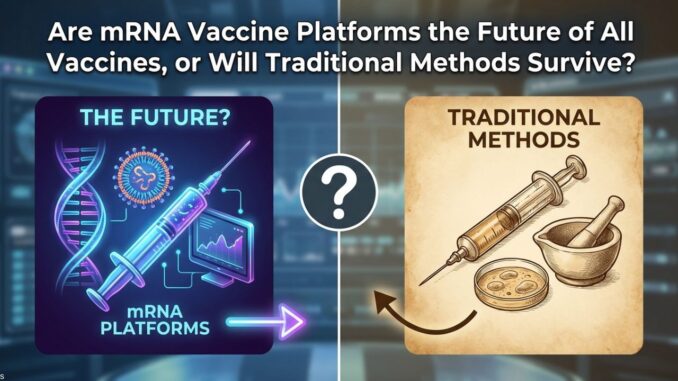
But five years after those first authorisations, the vaccine landscape has evolved in ways that complicate the simple narrative of mRNA as the technology that will replace everything that came before it. mRNA vaccine technology has expanded beyond COVID-19 into new applications. Traditional vaccine methods have also continued to advance. And the political and public confidence environment around mRNA vaccines has become more complex in several major markets. This essay examines whether mRNA platforms represent the future of all vaccines, or whether traditional methods will remain an important part of the global vaccine toolkit alongside them.
The Case For: mRNA Has Earned Its Place as the Leading Platform
The most important expansion of mRNA technology beyond COVID-19 is into cancer treatment, and the results here are genuinely striking. The mRNA-4157 personalised cancer vaccine, developed by Moderna in partnership with Merck, combines a patient-specific mRNA sequence encoding up to 34 tumour neoantigens with pembrolizumab, an established checkpoint inhibitor. Clinical trial results in 2024 and 2025 showed a 44% reduction in recurrence risk for melanoma patients compared to pembrolizumab monotherapy alone. This is not a modest incremental improvement in a well-served indication. It is a substantial clinical benefit achieved by an approach that had not existed as a practical product until mRNA manufacturing matured enough to produce personalised constructs.
The platform advantages of mRNA technology over traditional methods are structural, not incidental. Traditional vaccine development, whether using inactivated whole pathogens, live attenuated viruses, or recombinant protein subunits, requires growing and handling the target pathogen or producing specific proteins, a process that takes months to years. mRNA vaccine development requires knowing the genetic sequence of the target antigen, which can be obtained in days from genome sequencing, and synthesising the corresponding mRNA, a process that is now highly automated and scalable. The speed advantage was demonstrated definitively in the COVID-19 response, where the vaccine sequence was finalised within two days of the viral genome being publicly shared, and the entire development-to-authorisation timeline compressed to under a year.
Moderna’s mRNA-1345, an mRNA vaccine against respiratory syncytial virus targeting adults aged 60 and above, achieved 83.7% efficacy in Phase 3 trials and received FDA approval on 31 May 2024, becoming the first mRNA vaccine approved for an indication other than COVID-19. Over 120 clinical trials of RNA-based vaccines were underway across various malignancies by 2025, with first commercial approvals of RNA cancer vaccines expected by around 2029. The pipeline extends to influenza, tuberculosis, HIV, and numerous bacterial pathogens. The platform is not a one-pathogen achievement. It is a genuinely generalisable technology being applied across the full breadth of vaccinology. AI assistance in identifying optimal cancer targets has also reduced time to design personalised sequences significantly, and manufacturing improvements have compressed production timelines from nine weeks to under four weeks for personalised cancer vaccine constructs.
The Case For Traditional Methods: Why Legacy Platforms Will Survive
The case for traditional vaccine methods surviving alongside mRNA is not primarily a scientific one. It is an access, infrastructure, and public trust argument, and each of those dimensions is significant in the global vaccine landscape.
Cold chain requirements represent the most immediate practical constraint on mRNA vaccine deployment in lower-income countries. The original mRNA COVID-19 vaccines required ultra-cold storage, at minus 70 degrees Celsius for BNT162b2 in its original formulation, creating distribution challenges that limited rollout in countries without the necessary cold chain infrastructure. While formulation improvements have raised storage temperatures for later-generation mRNA vaccines, most traditional vaccine platforms remain more stable at standard refrigerator temperatures, giving them a logistics advantage in settings where vaccine access is most challenging and where the bulk of the unvaccinated population lives.
The public trust dimension is a real and material factor in the effectiveness of any vaccine programme. A 2025 analysis of the mRNA platform’s position noted that US policy decisions on COVID-19 mRNA vaccination recommendations for certain age groups, combined with persistent vaccine hesitancy in some populations, created a more complex public health communication environment than existed in 2021. In populations where scepticism of mRNA-specific technology is high, a vaccine programme delivered using a well-understood, decades-old traditional platform may achieve higher coverage than an equivalent mRNA vaccine even if the mRNA product has superior technical characteristics. Vaccine effectiveness is a product of both immunological performance and actual uptake rates, and these can diverge significantly.
Traditional platforms also retain genuine scientific advantages in specific applications. Live attenuated vaccines, such as the measles-mumps-rubella vaccine, yellow fever vaccine, and oral polio vaccine, generate particularly broad and durable immune responses by mimicking natural infection more closely than any synthetic platform currently achieves. For pathogens where T-cell immunity is as important as antibody responses, and where lifelong or near-lifelong protection is the goal, live attenuated vaccines remain the gold standard. Inactivated vaccines and protein subunit vaccines, while requiring traditional production methods, have proven safety records spanning decades and are appropriate for population groups where theoretical safety concerns about novel platforms, however well-characterised scientifically, represent a practical barrier to uptake.
What the Evidence Shows About the Balance
The evidence supports a picture in which mRNA vaccine technology has firmly established itself as the leading platform for rapid-response and oncology vaccine applications, while traditional methods retain important roles in global vaccine access, specific pathogen contexts, and populations where mRNA-specific hesitancy affects uptake.
The mRNA RSV approval in May 2024 is particularly significant as proof that the platform can expand beyond its COVID-19 origins into scheduled, non-emergency vaccination programmes for established pathogens. RSV is an indication previously addressed only by traditional platform vaccines and monoclonal antibody prophylaxis. An mRNA product competing here demonstrates that the technology can function in the routine vaccine market, not only in emergency pandemic responses where its speed advantages are most obvious.
The 120-plus ongoing RNA cancer vaccine trials represent an application category where traditional platforms have no equivalent. Personalised cancer vaccines based on a patient’s specific tumour mutation profile require the exact kind of rapid, sequence-based, individualised production that only mRNA and related RNA platforms can deliver. This opens an entirely new category of vaccine application rather than competing with traditional platforms for the same indications. It suggests that the relationship between mRNA and traditional vaccine methods is less a case of one replacing the other and more a case of each being optimally suited to different categories of application.
The Verdict: Partnership Rather Than Replacement
mRNA vaccine platforms are the future of vaccine development for rapid pandemic response, personalised cancer vaccines, and indications where speed of design iteration matters most. They will expand into an increasing proportion of the routine vaccine schedule over the next decade, particularly as formulation advances continue to address cold chain constraints and as real-world safety data accumulates across the expanded pipeline of approvals.
Traditional vaccine methods will survive and remain important for several categories of application: pathogens where live attenuated vaccines generate uniquely durable, broad immune responses that synthetic platforms have not yet replicated; populations in lower-income countries where cold chain infrastructure makes mRNA storage challenging; and population groups where hesitancy about mRNA-specific technology is high enough that coverage with a traditional platform vaccine exceeds what an mRNA equivalent would achieve. For these groups and these pathogens, traditional platforms are not simply inferior legacy systems. They are appropriate tools for specific contexts.
The framing of mRNA versus traditional vaccines as a competition with a single winner misrepresents how global vaccine programmes actually work. Different platforms serve different purposes, reach different populations, and have different optimal applications. The realistic future is a more diversified vaccine toolkit in which mRNA platforms take a leading and expanding share, particularly in high-income markets and in the oncology space where they have no equivalent, while traditional platforms continue to provide reliable, accessible tools for pathogens where they have proven records. The two categories of platform are more complementary than competitive, and the long-term vaccine landscape will be characterised by that complementarity rather than the wholesale replacement of one by the other. Questions about how regulatory frameworks keep pace with fast-moving biological technologies are equally relevant to the adjacent debate over whether veterinary gene therapy should be regulated as strictly as human gene therapy, where the same tension between enabling innovation and managing risk plays out in a less scrutinised regulatory context.
Leave a Reply