
The anti-aging industry has historically been associated with creams, serums, and cosmetic procedures promising to make people look younger, an industry built more on marketing and aesthetics than on biology. But over the past several years, a fundamentally different kind of anti-aging industry has emerged, one rooted in the science of geroscience, the study of the biological mechanisms of aging itself, with the explicit goal of extending not just appearance but genuine healthspan and lifespan. Longevity-focused startups attracted $8.5 billion in venture capital in 2024 alone, more than doubling from the prior year, and the broader longevity market is projected to grow from $5.3 trillion in 2023 to $8 trillion by 2030. Major pharmaceutical companies are no longer treating aging biology as a speculative side bet. They are building entire divisions around it.
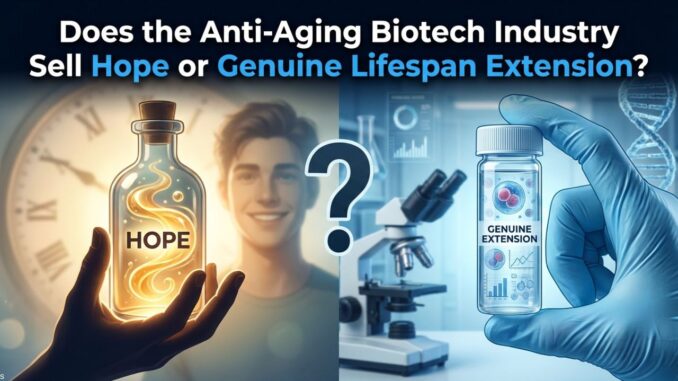
This essay examines whether this surge of investment and institutional attention reflects genuine scientific progress toward extending human lifespan, or whether the anti-aging biotech industry is, at its core, selling hope to a population increasingly anxious about aging, dressed in the credibility of biotechnology and venture capital rather than the rigour of proven clinical results.
The Case For: The Science Has Genuinely Matured
The single most significant development legitimising the longevity field has not come from a dedicated anti-aging company at all. It has come from drugs originally developed for entirely different purposes. GLP-1 receptor agonists, the class of drugs that includes Ozempic, Wegovy, and Mounjaro, were developed for diabetes and obesity. By 2025, the evidence had become difficult to ignore that these medications demonstrate effects across multiple hallmarks of aging simultaneously, recalibrating metabolic health, reducing inflammation, protecting cardiovascular and kidney function, lowering liver fat and fibrosis, and potentially enhancing cognitive resilience. The fact that drugs developed and approved for unrelated conditions are now being recognised as having broad effects on aging biology represents a different kind of validation than a longevity startup’s own clinical claims: independent regulatory approval for a different indication, followed by real-world data showing effects on aging-related outcomes.
A related and arguably even more striking development concerns SGLT2 inhibitors, another drug class developed for diabetes. Research published in 2024 and 2025 found that SGLT2 inhibitors can eliminate senescent “zombie” cells, the dysfunctional cells that accumulate with age and drive chronic inflammation, through enhanced immune surveillance, extend telomeres in human clinical trials, and prolong lifespan in animal models by up to 14%. One study found that henagliflozin lengthened telomeres in 90.5% of participants after just 26 weeks, compared to 65.6% in the placebo group. This is not a preliminary animal study or a theoretical mechanism. It is a human clinical trial showing a measurable biological effect on a recognised marker of cellular aging, in a drug that is already approved and prescribed for an unrelated condition.
Senolytics, drugs specifically designed to selectively kill senescent cells, represent the most direct translation of aging biology into therapeutic development. The concept, introduced by researchers Kirkland and Tchkonia in 2015, is grounded in well-established cell biology: senescent cells accumulate with age, with 30% to 70% of senescent cells in aged tissue actively contributing to dysfunction through the secretion of inflammatory molecules collectively termed the senescence-associated secretory phenotype. Clearing these cells has been shown in preclinical studies to enhance tissue function, delay the onset of age-related diseases, and extend lifespan in animal models. The biological mechanism is not speculative. It is built on decades of cell biology research into what senescent cells are and why they accumulate.
The clinical trial landscape by late 2025 reflects a field shifting from scattered preclinical experiments toward a more standardised approach. As 2026 approaches, the longevity field has been moving toward fewer, more focused clinical evaluations, with researchers explicitly calling for clinical standardisation appropriate to what they describe as a new biomedical science discipline. Multiple human longevity trials are now listed on clinicaltrials.gov, representing a level of clinical infrastructure that did not exist for this field even five years ago. Metformin, a decades-old diabetes drug with an exceptional safety record, is the subject of large-scale clinical trials investigating its potential anti-aging effects, and if successful could become the first widely approved longevity intervention, providing a template for how other interventions might progress through regulatory pathways.
The Case Against: The Gap Between Mouse Models and Human Outcomes
The most important caveat to the senolytics story, and to longevity biotech more broadly, is the gap between what has been demonstrated in animal models and what has been demonstrated in humans over a meaningful timeframe. Despite the substantial promise attributed to senolytics, only two studies have actually shown lifespan extension by senolytics in mammals. Fisetin extended lifespan in a small mouse study. A combination of dasatinib and quercetin increased median lifespan in mice by approximately 6.3%, from 937 days to 996 days. These results are genuinely meaningful as proof-of-concept findings, but a 6.3% lifespan extension in mice, achieved in a small number of studies, is a long way from a demonstrated human lifespan extension effect, and the translation from mouse lifespan studies to human outcomes has a long history of failing to replicate in the longevity field specifically and in pharmaceutical development more broadly.
There is also a meaningful scientific debate about mechanism that the popular coverage of senolytics often glosses over. Some researchers argue that the modest lifespan extension observed with combinations like dasatinib and quercetin may be explained not primarily by the clearance of senescent cells, the mechanism the senolytic concept is built around, but by off-target effects such as mTOR inhibition, a different and already well-studied longevity pathway. If the lifespan effects of current senolytic candidates are substantially driven by off-target mechanisms rather than the senolytic mechanism itself, this raises questions about whether the broader senolytic concept, killing senescent cells specifically, has been validated as a lifespan-extension strategy at all, as opposed to these specific drugs happening to have other beneficial effects.
The investment surge itself deserves scrutiny as a signal. $8.5 billion in venture capital flowing into longevity startups in a single year, more than doubling from the prior year’s downturn, reflects investor enthusiasm and market narrative momentum as much as it reflects scientific validation. Venture capital has a well-documented history of flowing rapidly into fields with compelling narratives well before clinical validation catches up, and the eventual outcomes for those investments, and for the patients who may access unproven interventions marketed on the back of that investor enthusiasm, are not guaranteed to track the scientific reality. The $8 trillion longevity market projection for 2030 is a market size estimate, not a measure of how much of that spending will be on interventions with genuine, demonstrated effects on human lifespan versus interventions marketed on the promise of aging science without proportionate evidence.
The framing of the GLP-1 and SGLT2 inhibitor findings also requires care. These drugs were developed and approved for diabetes and obesity, and their effects on markers associated with aging, telomere length, senescent cell burden, inflammation, are genuinely documented in human trials. But “improves markers associated with aging” and “extends human lifespan” are not the same claim. Telomere length and senescent cell clearance are biomarkers, proxies that correlate with aging processes, not direct measures of how long someone will live. The relationship between improving these biomarkers and actually extending lifespan in humans, over the decades-long timeframes that would be required to demonstrate it directly, remains an inference rather than a demonstrated outcome.
What the Evidence Supports
The evidence supports a conclusion that sits between “selling hope” and “genuine lifespan extension,” and the most accurate description is that the anti-aging biotech industry has moved decisively from the former toward genuine biological science, without yet having crossed the threshold into demonstrated human lifespan extension.
The repurposing of GLP-1 and SGLT2 inhibitor drugs represents the strongest current evidence in the field, precisely because these effects were not discovered by longevity-focused companies seeking to validate a pre-existing commercial thesis. They were discovered through real-world clinical data on drugs already in widespread use for other conditions, which provides a level of evidential independence that purpose-built longevity startup trials do not yet have. The biomarker improvements documented, telomere lengthening, senescent cell reduction, are real, measured, and replicated across studies. What remains unresolved is the translation from biomarker improvement to lifespan extension, a translation that, by its nature, can only be demonstrated through long-term human studies that are still in early stages.
The senolytics story illustrates the field’s current state precisely: a scientifically coherent mechanism, grounded in established cell biology, with genuine preclinical lifespan extension results in animal models, but with only two studies demonstrating that effect, modest effect sizes even where demonstrated, and active scientific debate about whether the proposed mechanism is even the correct explanation for the results observed. This is not a field selling pure hope. It is a field with real preliminary results that are being marketed, in some cases, with a confidence that exceeds what those results actually support.
The Verdict: Real Science, Overconfident Marketing
The anti-aging biotech industry is not simply selling hope, and dismissing it as such would understate the genuine scientific progress that has occurred. The repurposing of GLP-1 and SGLT2 inhibitor drugs based on real human clinical data represents a qualitatively different and more credible form of evidence than the longevity field has historically had access to. Senolytics are grounded in established, peer-reviewed cell biology, not speculative theory. The shift toward standardised human clinical trials, rather than scattered animal studies and anecdotal claims, represents a field maturing in the direction that credible biomedical research disciplines mature.
At the same time, the industry is not yet delivering genuine, demonstrated lifespan extension in humans, and the gap between biomarker improvements and actual lifespan outcomes remains the central unresolved question. The $8.5 billion in venture capital flowing into the sector in 2024 reflects investor confidence in the trajectory of the science, not validated outcomes, and the history of biomedical fields suggests that investor enthusiasm reliably outpaces clinical validation by years if not decades. The honest position is that the underlying science is genuinely promising and has made real progress, but anyone marketing current longevity interventions as proven lifespan-extension therapies, rather than as promising candidates with documented biomarker effects and ongoing trials, is overstating what the evidence currently supports.
For consumers navigating this landscape, the practical distinction worth holding onto is between interventions with independent, replicated human clinical data on aging-relevant biomarkers, such as the SGLT2 inhibitor telomere findings, and interventions whose claims rest primarily on animal studies, mechanistic plausibility, or the reputation and funding of the company promoting them. The former represents the genuine frontier of the field. The latter, while not necessarily fraudulent, is where the gap between hope and proof remains widest. The same distinction between mechanistically plausible science and demonstrated human outcomes runs through other corners of biotechnology making ambitious claims about the future, including the question of whether bioprinted organs could realistically eliminate transplant waiting lists by 2040, where similarly genuine progress coexists with timelines that frequently outpace what the underlying science has actually demonstrated. The same careful distinction between platform promise and demonstrated outcomes applies to the debate over whether mRNA vaccine platforms will replace all traditional vaccine methods, a technology that has moved fastest when its genuine advantages were matched by realistic expectations about what it can and cannot yet deliver.
Leave a Reply